Renters in Olympia, WA often overlook one critical gap in their protection: a landlord’s insurance policy doesn’t cover your personal belongings or liability. We at Cross Insurance Agency see this mistake repeatedly, and it leaves renters vulnerable to significant financial loss.

The good news is that renters insurance in Olympia, WA is affordable and straightforward to obtain. This guide walks you through what coverage you actually need and how to find the best rates for your situation.

Why Your Landlord’s Insurance Won’t Protect Your Stuff

Your landlord’s insurance policy covers the building structure, the roof, and the walls-nothing more. It does not cover your personal belongings, and it absolutely does not cover your liability if you cause damage or someone gets injured in your apartment. This is the fundamental reason renters insurance exists, and it’s non-negotiable in Olympia. Renter insurance usually only covers your property’s actual cash value at the time it was damaged, destroyed, or stolen, which means a fire, theft, or water damage can wipe out thousands of dollars of your possessions with zero recovery. Many Olympia landlords now require proof of renters insurance as a lease condition, often asking for at least $100,000 in liability coverage, which tells you how serious this gap is. If a guest slips on your kitchen floor and breaks their leg, your landlord’s policy will not pay their medical bills or legal fees-yours will, if you have liability coverage. Without it, you could face a lawsuit that attaches your wages or bank account.

What Your Personal Property Actually Costs

Most renters dramatically underestimate the value of their belongings. Furniture, electronics, clothing, kitchen items, and bedding add up fast. A standard renters policy in Washington typically starts around $15,000 to $30,000 for personal property and $100,000 to $300,000 for liability. If a kitchen fire destroys your apartment, you’ll want replacement cost coverage, not actual cash value, because depreciation will leave you short. In Olympia, renters insurance costs between $159 and $249 per year, placing your monthly cost around $13 to $21, which is less than a coffee subscription.
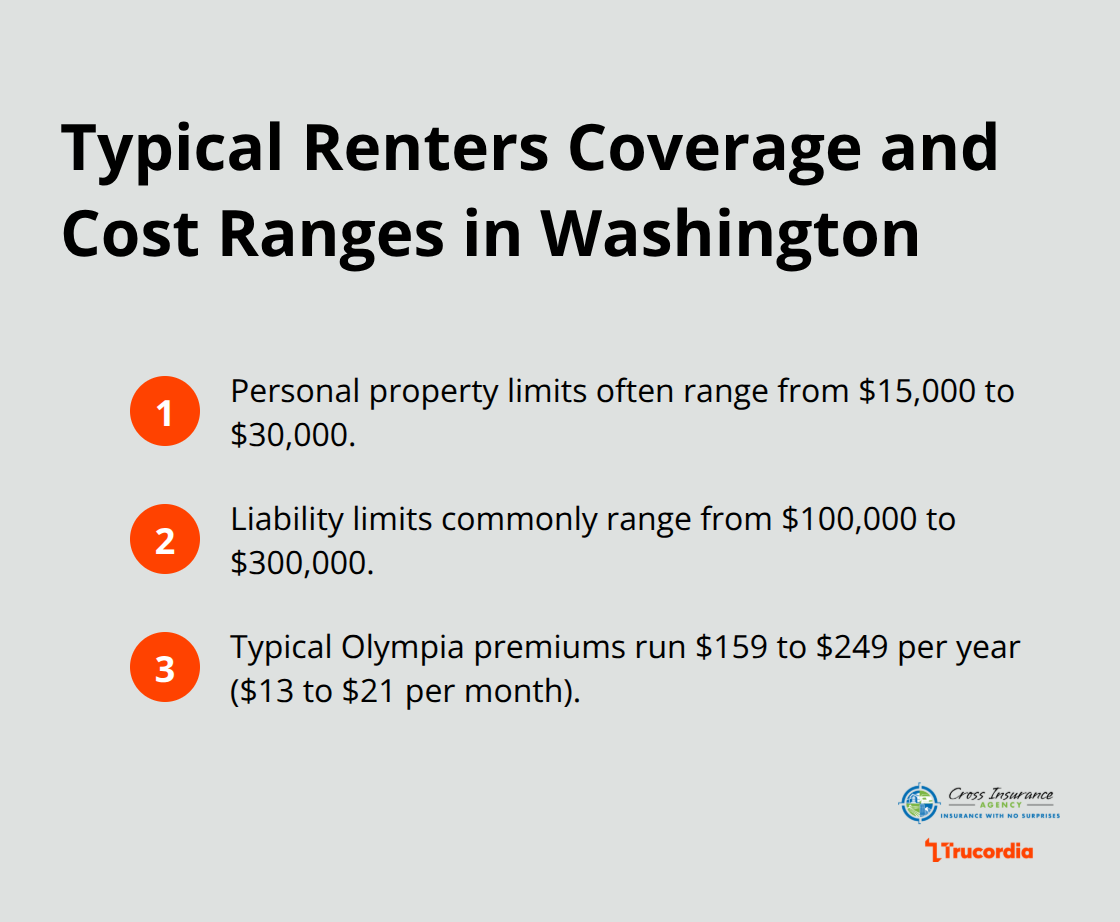
Quick view of common renters insurance coverage limits and Olympia cost ranges. - renters insurance Olympia WA

When You Can’t Stay in Your Apartment

If a covered loss makes your rental uninhabitable, additional living expenses coverage pays for temporary housing, meals, and other reasonable costs while repairs happen. This coverage has saved renters thousands of dollars when a burst pipe, electrical fire, or other disaster forces them out for weeks or months. Without it, you absorb hotel costs, restaurant meals, and storage fees entirely out of pocket. Most policies cover these expenses up to your policy limit, so confirm what your limit is when you obtain a quote. This coverage matters most in scenarios like a kitchen fire in Spokane or a burst pipe in Seattle-real situations that happen to Washington renters regularly. Olympia renters should treat this as a non-negotiable part of their policy, not an optional add-on.

How Liability Coverage Protects Your Financial Future

Liability coverage protects you when someone sues you for injuries or property damage you caused. A guest trips on your stairs and fractures their arm; they file a claim against your renters policy instead of taking you to court personally. Your liability coverage pays their medical expenses and legal fees (up to your policy limit), which shields your paycheck and savings account from attachment. Without this protection, a single lawsuit can cost you tens of thousands of dollars in legal defense alone, even if you win. Olympia renters who host friends, family, or colleagues should view liability coverage as essential protection, not a luxury. The cost to add substantial liability limits remains remarkably low-often just a few dollars more per month than a bare-bones policy.

Taking the Next Step Toward Protection

Now that you understand what your landlord’s policy won’t cover and what renters insurance actually protects, the next step is to compare quotes from multiple carriers and find the coverage limits that match your actual belongings and risk profile.

What Washington Renters Insurance Actually Covers

Personal Property Protection Reimburses Your Belongings

Washington renters policies protect three core areas of your financial life, and understanding exactly what falls under each one prevents nasty surprises when you file a claim. Personal property coverage reimburses you for belongings damaged, destroyed, or stolen up to your policy limit, whether the loss occurs inside your apartment or anywhere else. If your laptop gets stolen from a coffee shop in downtown Olympia or your suitcase gets damaged during a move, this coverage handles it.

Most Washington policies start at $15,000 to $30,000 for personal property, but according to Mosaic Insurance Alliance, many renters underestimate their actual belongings value at $20,000 to $40,000. You should inventory your furniture, electronics, clothing, and kitchen items before you choose a limit. The choice between actual cash value and replacement cost matters significantly: actual cash value pays depreciated amounts, while replacement cost pays what you’d spend today to replace items, costing roughly $2 to $5 more per month but delivering far better protection when major losses occur.

Liability Coverage Shields You from Lawsuits

Liability coverage protects your finances when someone is injured in your rental or you damage their property, and this is where most Olympia renters face their biggest exposure. If a guest slips on your stairs and breaks their leg, your liability coverage pays their medical bills and legal fees up to your policy limit instead of forcing them to sue you personally. Standard policies offer $100,000 to $300,000 in liability limits, and many Olympia landlords now require at least $100,000 as a lease condition, so meeting that threshold is non-negotiable.

Medical Payments Coverage Acts Independently

Medical payments coverage for guests fills a different role than liability: it pays eligible medical expenses for injuries guests sustain in your rental regardless of fault. You don’t have to prove you were responsible for the accident. This coverage typically covers medical treatment up to a set limit per person and per incident, and it moves quickly without requiring the injured person to file a lawsuit.

Additional Living Expenses Keep You Afloat

Additional living expenses coverage rounds out the core protections by paying for temporary housing, meals, and related costs if a covered loss makes your rental uninhabitable while repairs happen. Olympia renters should verify their personal property limit actually matches what they own, because underinsuring leaves you absorbing the gap yourself when disaster strikes.

Washington renters insurance costs between $159 and $249 per year according to Mosaic Insurance Alliance, making these three core protections remarkably affordable compared to the financial devastation they prevent. When you compare quotes, keep your deductible consistent across carriers so premiums stay comparable, and choosing a $1,000 deductible instead of $500 typically saves $30 to $60 annually. Standard renters policies cover approximately 16 named perils including fire, theft, and vandalism, but earthquake and flood damage require separate riders or policies. Before you assume you’re covered for every scenario, confirm what your specific policy includes-this distinction becomes critical when you actually need to file a claim.
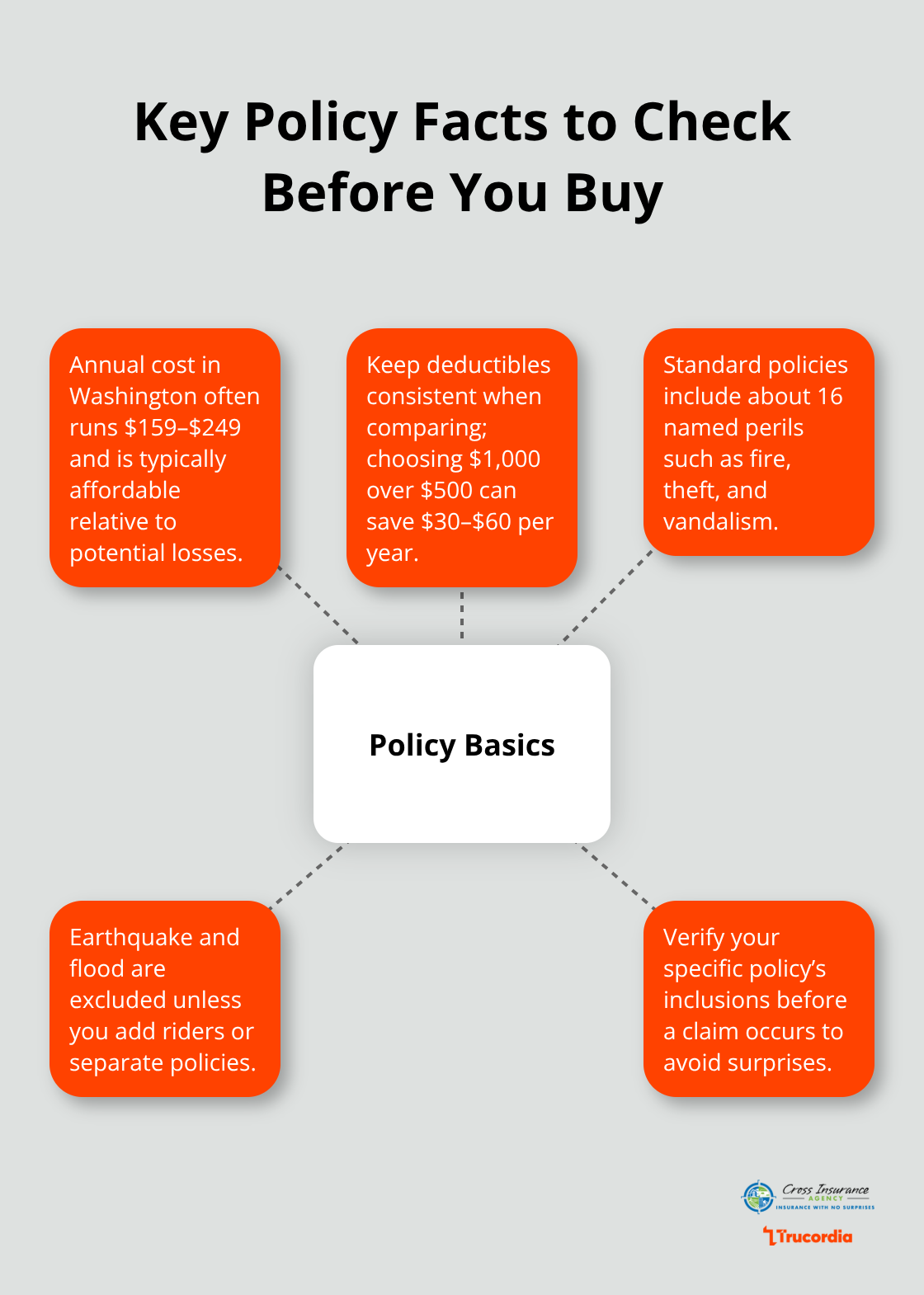
Hub-and-spoke showing essential renters insurance details to verify in Washington. - renters insurance Olympia WA

How to Find the Best Renters Insurance Price in Olympia

Compare Quotes from Multiple Carriers

Olympia renters who accept the first quote they receive typically pay 20 to 30 percent more than necessary. Premiums vary dramatically based on how each insurer calculates risk, so a policy costing $18 per month with one carrier might cost $24 with another despite nearly identical coverage. Start your quotes with basic information: your name, date of birth, address, and details about others living with you full-time. Most carriers now offer online quotes that provide estimates immediately, though the full quote process typically takes 24 to 48 hours after submission.
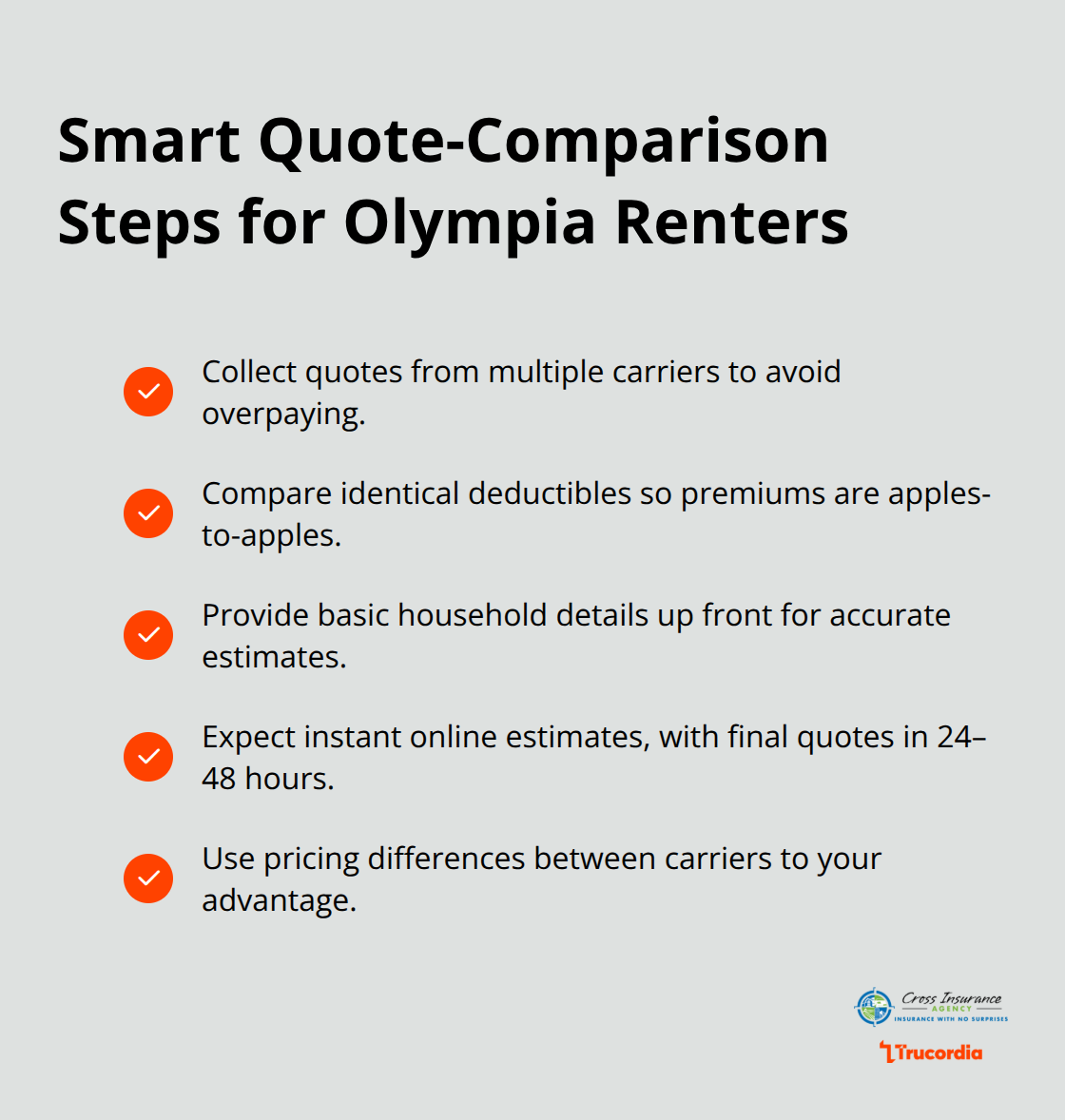
Checklist of steps to compare renters insurance quotes effectively in Olympia, WA.

Don’t rely on advertised headline prices, as that $5-per-month figure floating around usually doesn’t apply to your specific Olympia situation. Regional price differences within Washington are substantial; according to Mosaic Insurance Alliance, Seattle-area renters often pay significantly more than Eastern Washington renters due to higher claim frequency and property values. Your credit-based insurance score also matters considerably, so mention recent credit improvements when you compare quotes.

Bundle Auto and Renters Insurance for Substantial Savings

The fastest way to cut your premium is combining renters insurance with auto insurance, which typically saves 10 to 25 percent on both policies. Many Olympia renters overlook this option and purchase renters insurance alone, leaving significant money on the table. When you compare quotes across carriers, keep your deductible consistent so the numbers stay comparable. Choosing a $1,000 deductible instead of $500 usually saves $30 to $60 per year, so calculate what you could actually afford to pay out-of-pocket if a claim occurred.

Select Coverage Options That Match Your Situation

Your choice between actual cash value and replacement cost coverage affects your monthly payment; replacement cost costs roughly $2 to $5 more per month but delivers significantly better payouts when major losses occur (making it worth the small premium increase for most renters). Buying online rather than through an agent typically unlocks an additional discount. Once you narrow your options to two or three carriers, contact an independent agent in Washington who can access multiple insurers and potentially uncover discounts you wouldn’t find shopping alone. These agents work with top-rated carriers and can help you assemble documents needed to show proof of coverage to landlords.

The quote comparison process requires effort, but saving $50 to $100 per year on a policy you’ll carry for years makes that investment worthwhile.

Final Thoughts

Renters insurance in Olympia, WA protects you against the exact financial disasters that landlord policies ignore, and you can obtain comprehensive coverage for $13 to $21 per month. A kitchen fire, a guest’s injury lawsuit, or a burst pipe that forces you out for weeks can cost thousands of dollars in damages, medical bills, and temporary housing expenses-protection that costs less than a streaming subscription. The three core coverages (personal property, liability, and additional living expenses) address real gaps in your financial security, and Washington’s competitive market means you have genuine options to customize coverage around your actual situation.

Your next move is to stop accepting the first quote you receive and instead compare options across multiple carriers, since regional price differences within Washington are substantial and your credit score, deductible choice, and bundling decisions can shift your annual premium by $50 to $100 or more. An independent agent can access multiple top-rated carriers and help you find discounts you wouldn’t discover shopping alone, plus they can assist with assembling proof of coverage documents your landlord requires. We at Cross Insurance Agency connect Olympia renters with tailored coverage from multiple carriers and provide ongoing claims advocacy when you actually need it.

Contact us today to compare quotes and find the right renters insurance policy for your situation.

Disclaimer: The information provided in this blog is for general informational purposes only and does not constitute legal, financial, or insurance advice. Coverage options, terms, and availability may vary. Please consult with a licensed professional for advice specific to your situation. Artificial intelligence may have been used to generate text and images in some blog articles.
Your business space is one of your biggest investments. Without commercial property insurance in Washington, a single fire, theft, or storm could wipe out years of hard work and capital.

At Cross Insurance Agency, we help Washington business owners understand what coverage they actually need and how to protect their assets without overpaying. This guide walks you through the essentials of commercial property insurance WA so you can make confident decisions about your coverage.

What Commercial Property Insurance Covers in Washington

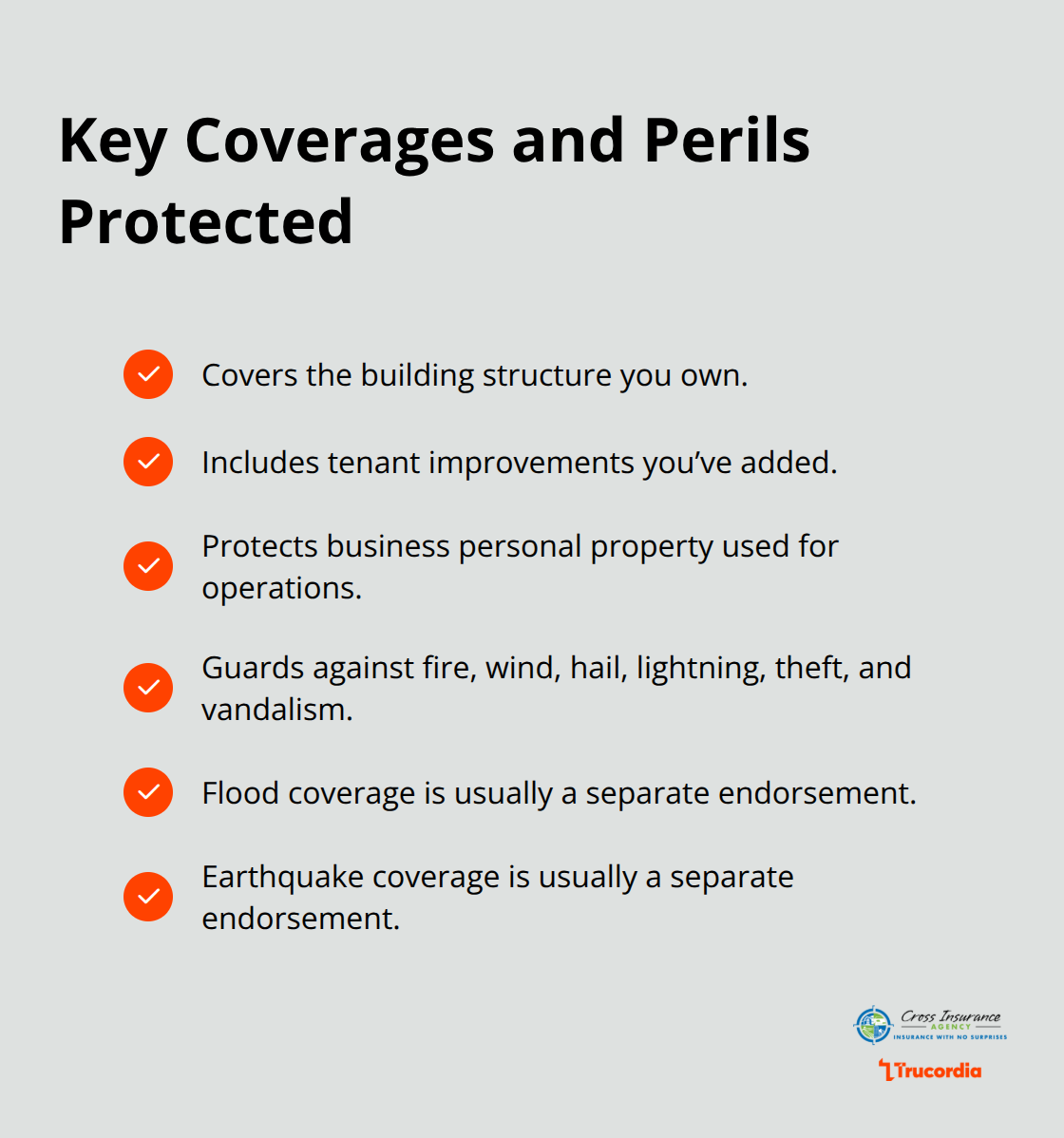
Commercial property insurance protects the physical assets that keep your business running. The policy covers your building structure if you own it, including the roof, walls, foundation, and permanent fixtures like built-in shelving or HVAC systems. If you lease, your landlord’s policy covers the building itself, but you need your own coverage for interior improvements you’ve made-new flooring, custom walls, upgraded lighting. Those tenant improvements have real replacement value.

Building Structure and Tenant Improvements

Your business personal property receives coverage too: office equipment, furniture, inventory, machinery, tools, and anything else you own that’s used for operations. Standard policies protect against fire, wind, hail, lightning, theft, and vandalism. Flood and earthquake coverage typically require separate policies or endorsements, so if your Washington location sits near water or in a seismic zone, you need to request those additions explicitly.

Summary of what Washington commercial property insurance typically covers and where separate endorsements apply

The coverage applies whether items are inside the building or outside, like signage and equipment stored on your property.

Income Protection During Downtime

Loss of income coverage is where many Washington businesses fall short. If a fire or major storm forces you to close for weeks or months, this coverage pays your regular business income while you rebuild. It also covers extra expenses you incur to keep operating-renting temporary space, expedited shipping for replacement equipment, or paying employees to work offsite. Without this protection, you lose revenue twice: once from the damage itself and again from the downtime.

Replacement Cost vs. Actual Cash Value

Replacement cost coverage is non-negotiable. It pays to rebuild or replace your assets with new materials without deducting depreciation, while actual cash value coverage deducts depreciation and often leaves you significantly underinsured. Construction costs in Washington have risen steadily, and equipment prices fluctuate, so your coverage limits need regular updates to match current replacement expenses. You should review your policy annually or whenever you add equipment, expand inventory, or make building improvements.

The specifics of what your policy covers depend on the form you select and the endorsements you add. Understanding these details now helps you avoid gaps that could expose your business to serious financial risk.

Why Washington Businesses Need Commercial Property Insurance

Washington’s natural environment and business landscape create real exposure that most owners underestimate. The Pacific Northwest experiences significant wind and hail damage annually, and coastal properties face storm surge risk. According to the National Oceanic and Atmospheric Administration, the U.S. sustained 403 weather and climate disasters from 1980–2024 where overall damages reached or exceeded $1 billion. Beyond weather, commercial properties attract theft and vandalism-retail spaces, construction sites, and equipment storage yards face constant risk. Fire damage remains one of the costliest perils; a single electrical fire or cooking accident destroys inventory, equipment, and the building itself within hours. Without commercial property insurance, you absorb these losses entirely from operating capital or savings. Most Washington business owners cannot recover from a major loss without coverage, and that financial exposure threatens not just the business but personal assets and employees’ livelihoods.

Lenders and Landlords Require Coverage

Financial institutions and landlords make commercial property insurance non-negotiable. If you financed your building, your lender requires proof of coverage before releasing funds and continues requiring it throughout your loan term. Landlords demand the same for tenant spaces-they protect their investment by mandating that you carry coverage for your improvements and contents. Many lease agreements specify minimum coverage limits and require the landlord as a named additional insured on your policy. Violating these requirements breaches your lease or loan documents and gives lenders grounds to cancel financing or landlords grounds to evict. Business owners often discover mid-claim that their coverage falls short of contractual requirements, leaving them personally liable for the gap. The practical step is straightforward: pull your lease and loan documents now, identify the coverage requirements, and confirm your current policy meets them exactly.

Uninsured Losses Devastate Cash Flow

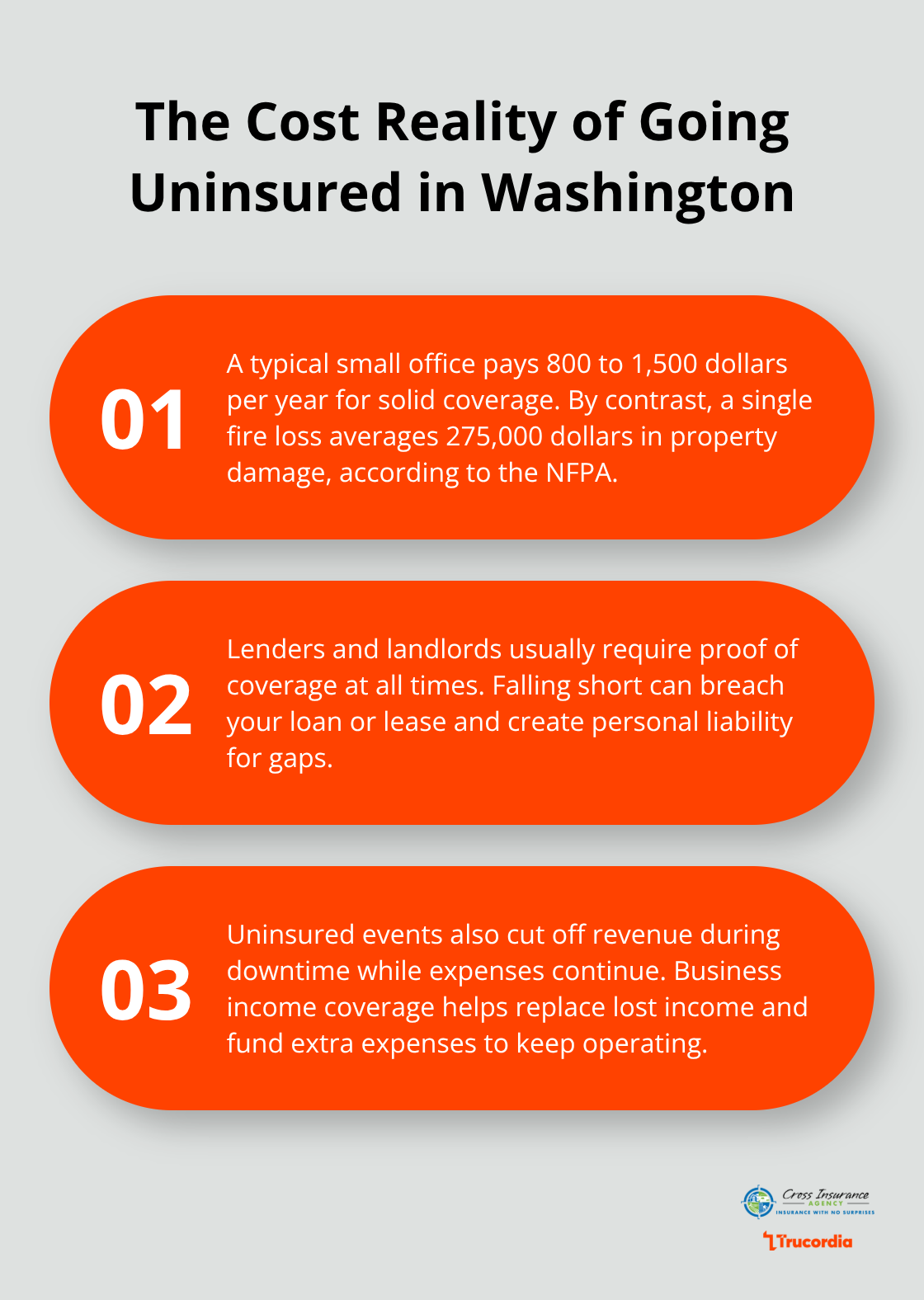
Uninsured losses hit your bottom line immediately and hard. A restaurant fire that closes you for four months costs far more than rebuilding-you lose rent, employee wages, loan payments, and revenue simultaneously. A retail theft of 15,000 dollars in inventory damages your cash flow significantly if you self-insure. Equipment breakdown at a manufacturing facility idles your entire operation for weeks while you source replacement parts. These scenarios happen regularly in Washington businesses. The cost of commercial property insurance represents a small fraction of what one significant loss would cost. A typical small office pays 800 to 1,500 dollars annually for solid coverage, while a single fire loss averages 275,000 dollars in property damage according to the National Fire Protection Association.

Comparison of premiums, average fire losses, contractual requirements, and downtime impacts for WA businesses - commercial property insurance WA

Coverage costs pennies compared to the financial catastrophe of an uninsured event.

Your Next Step: Assess Your Coverage Gaps

Business owners who skip or skimp on coverage are betting their business on luck, which is a terrible strategy. The question isn’t whether you can afford commercial property insurance-it’s whether you can afford not to have it. Your next move is to evaluate what your current policy actually covers and identify where gaps exist. This assessment sets the stage for choosing the right coverage limits and endorsements that match your specific business operations and asset values.

How to Choose the Right Commercial Property Insurance Policy

Document Your Assets With Precision

Start with a detailed inventory of what you own. Walk through your building and document every asset: the square footage and construction type of the structure itself, the age of the roof and major systems, equipment and machinery with purchase dates and current values, inventory stock levels, furniture and fixtures, outdoor signage and storage items. Write down replacement costs, not what you paid five years ago. A used desk might have cost 400 dollars, but replacing it today costs 600 dollars.

Commercial construction costs in Washington have climbed steadily. Your policy limits must reflect current replacement expenses, not historical purchase prices. Many business owners underestimate inventory value significantly. A retail clothing shop might carry 40,000 to 60,000 dollars in stock at any given time, but owners often insure for 25,000 dollars because they haven’t counted systematically.

Manufacturing operations frequently undervalue machinery and specialized tools. Schedule a time to photograph equipment, note serial numbers, and gather recent receipts or appraisals. This documentation serves two purposes: it gives your insurance agent accurate numbers and creates a claims record if loss occurs. Once you have this inventory, calculate the total replacement cost for your building structure, contents, and business improvements separately. This three-part breakdown reveals exactly where your exposure sits.

Compare Policies Across Multiple Carriers

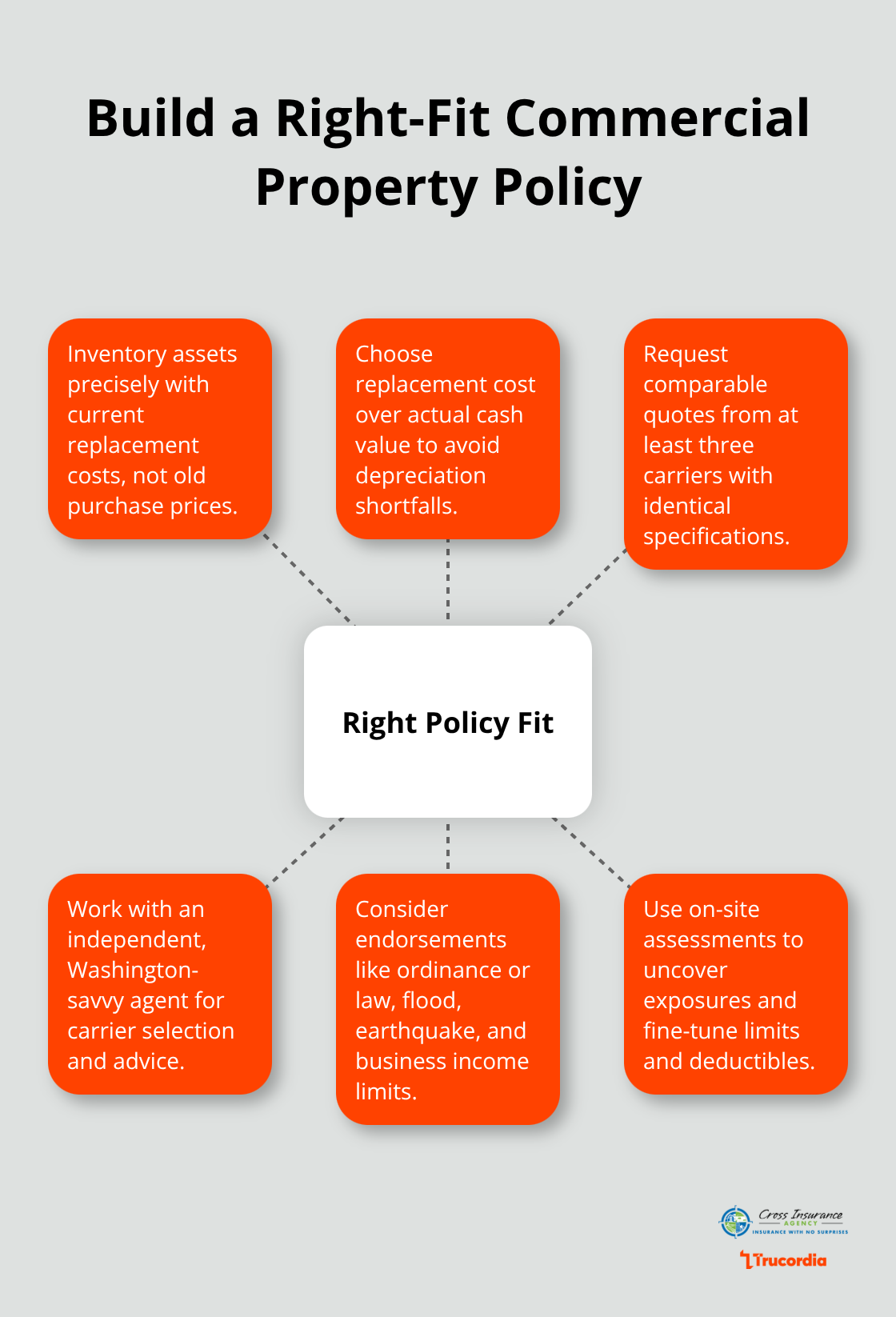
Key steps to tailor commercial property insurance for a Washington business - commercial property insurance WA

Comparing policies across carriers matters far more than most owners realize, but the comparison must be structured. Request quotes from at least three insurers using identical coverage specifications, limits, and deductibles so you see actual price differences rather than apples-to-oranges comparisons. Ask specifically about replacement cost versus actual cash value, whether ordinance and law coverage is included or optional, and what loss of income coverage limits are available.

A 500,000 dollar property limit with a 1,000 dollar deductible from one carrier might cost 1,200 dollars annually, while another charges 950 dollars for identical coverage. That 250-dollar difference compounds over years. However, price alone shouldn’t drive your decision. Examine each carrier’s claims process and response time. Look at whether the carrier offers risk assessment services; some insurers send engineers to identify exposures and recommend loss-prevention improvements that can reduce your premiums.

Work With Independent Agents Who Know Washington

Work with an independent agent who represents multiple carriers rather than captive agents tied to a single insurer. Independent agents shop multiple top-rated carriers to deliver genuine choice and competitive pricing tailored to your specific business and location. This approach reveals which insurers offer the best terms for your industry and risk profile. A contractor faces different underwriting considerations than a retail shop, and a coastal property faces different weather exposure than an inland location.

Local agents understand Washington’s specific risk landscape-the seismic activity in certain regions, flood patterns near rivers and Puget Sound, wind exposure on the coast, and crime rates in different neighborhoods. These factors directly influence both premium costs and available coverage options. An agent familiar with Washington commercial property insurance can advise whether your location warrants flood coverage as a priority or whether earthquake coverage makes sense given your property’s location. They can also identify endorsements that strengthen your protection without excessive cost.

Leverage On-Site Assessments

Request an on-site consultation if your business is complex or your asset values are substantial. A local agent can walk your property, spot exposures you’ve missed, and recommend specific coverage enhancements. This consultation costs nothing and often reveals gaps that save you money long-term by preventing underinsurance claims. The relationship with your agent becomes invaluable when a loss occurs and you need someone who understands your business and your policy intimately.

Final Thoughts

Commercial property insurance WA protects your business from financial devastation when loss strikes. The coverage you carry directly determines whether your business survives a major event or collapses under the weight of uninsured losses. A fire, theft, or storm can destroy years of investment in weeks, but the right policy transforms that catastrophic risk into a manageable expense.

Document what you own with precision, gather your lease and loan documents to identify coverage requirements, and request quotes from multiple carriers using identical specifications so you see genuine price differences. Work with an independent agent who represents several top-rated insurers and understands Washington’s specific risk landscape, from coastal storm exposure to seismic activity in certain regions. The cost of commercial property insurance is negligible compared to the financial catastrophe of an uninsured loss-a typical small office pays 800 to 1,500 dollars annually for solid coverage, while a single fire loss averages 275,000 dollars in property damage.

We at Cross Insurance Agency connect Washington business owners with tailored commercial property coverage that matches their specific assets and operations. Our licensed agents shop multiple carriers to deliver genuine choice, competitive pricing, and personalized guidance. Contact us today to review your coverage and get a quote that reflects your actual replacement costs and risk exposure.

Disclaimer: The information provided in this blog is for general informational purposes only and does not constitute legal, financial, or insurance advice. Coverage options, terms, and availability may vary. Please consult with a licensed professional for advice specific to your situation. Artificial intelligence may have been used to generate text and images in some blog articles.
Washington landlords face wildly different insurance costs depending on where their properties sit and what coverage they choose. Getting landlord insurance quotes in WA requires comparing apples to apples-same coverage levels, same deductibles-or you’ll end up confused by the numbers.

We at Cross Insurance Agency help landlords cut through the noise and find rates that actually fit their budgets. This guide walks you through the exact steps to compare quotes, spot savings opportunities, and avoid overpaying for coverage you don’t need.

What Drives Landlord Insurance Costs in Washington

Washington landlords rarely pay the same premium for identical coverage, and that’s because insurers weight risk factors differently across properties. Your location matters enormously-a rental in Seattle faces different weather patterns and liability exposure than one in Spokane or a rural area. Properties near flood zones, in high-crime neighborhoods, or in older buildings with outdated electrical systems get flagged as higher risk, pushing premiums up significantly.

Visual map of factors that raise or lower landlord insurance premiums in Washington - landlord insurance quotes WA

Location and property condition set the baseline

The age of your building and its systems directly impact what you’ll pay; a 1970s rental with original plumbing costs more to insure than a 2015 property with modern infrastructure. Local weather patterns also play a role-properties in areas prone to hail or wind damage face steeper rates than those in lower-risk zones. Insurers assess your roof, foundation, and major systems during underwriting. Visible deferred maintenance translates directly into higher quotes because it signals elevated claims risk.

Liability limits shape your bottom line

The liability protection you select has the biggest impact on your quote. A $300,000 liability limit costs far less than $1 million, but that lower limit leaves you exposed if someone sues after an injury on your property. Loss-of-rent coverage-which reimburses you when a unit sits vacant after a covered loss-adds cost but protects your income during repairs. Try selecting limits that match your actual exposure rather than defaulting to the cheapest option; underinsurance creates far bigger problems than slightly higher premiums.

Tenant history and maintenance records affect pricing

Insurers scrutinize your tenant history and how well you maintain the property. Properties with frequent turnover, eviction records, or documented maintenance issues receive higher quotes because they signal elevated claims risk. A well-maintained rental with stable, long-term tenants costs less to insure than one with constant vacancy or damage claims. If your property has had previous claims, expect premiums to reflect that history. Conversely, a five-year claims-free track record qualifies you for discounts that can meaningfully reduce your annual cost.

Understanding these cost drivers helps you anticipate what insurers will charge and identify where you can reduce risk. The next step involves comparing quotes strategically-making sure you’re actually comparing the same coverage across different carriers rather than mixing different protection levels.

Matching Coverage to Get Accurate Quotes

Request identical coverage across all carriers

True rate comparisons demand discipline: you must request identical coverage across every quote or the numbers mean nothing. Many Washington landlords grab three quotes and pick the cheapest, only to discover later that one policy includes loss-of-rent coverage while another excludes it entirely.

Compact checklist of items to request identically across all landlord insurance quotes - landlord insurance quotes WA

Start by listing your exact coverage needs-dwelling protection amount, liability limit (try for at least $1 million), loss-of-rent duration, and any add-ons like water backup or wind damage protection. When you contact carriers, specify these details identically to each one.

Standardize deductibles and coverage periods

Request the same deductible amount across all quotes; a $500 deductible versus a $1,000 deductible creates a false price comparison. The deductible choice matters significantly-jumping from $500 to $1,000 typically saves 10–15% annually, but only if your emergency fund can absorb that higher out-of-pocket cost after a loss. Washington landlords particularly need to confirm whether quotes include vacant-period coverage since properties between tenants face different risk exposure. Proper Insurance and BiBerk both offer online quote tools that let you input these specifics upfront, while Travelers and American Family typically require agent contact but provide more detailed underwriting.

Evaluate actual coverage details beyond the base premium

Once you have apples-to-apples quotes, evaluate what each policy actually covers beyond the base premium. Steadily and BiBerk emphasize transparent online processes showing exact coverage limits upfront, while agent-based quotes from Travelers sometimes bury critical details. Short-term rental landlords should verify that standard quotes exclude Airbnb or Vrbo properties-Proper Insurance specifically covers these situations with up to $3 million liability and guest-damage protection that standard policies omit entirely. Check whether each policy includes inflation protection, which automatically adjusts your dwelling coverage limits as construction costs rise; this prevents gradual underinsurance over time.

Document discounts and exclusions before comparing prices

Ask about available discounts explicitly-claims-free discounts for five-plus years without losses, multi-policy bundling, and paperless billing discounts vary by carrier and state. Document each quote’s liability limits, loss-of-rent coverage period (30 days versus 180 days makes a real difference), deductible, and any exclusions around water damage or earthquake coverage before you compare prices. These details separate policies that truly protect your rental income from those that leave you exposed when you need coverage most. With standardized quotes in hand, you can now identify which carriers offer the best value for your specific property risk profile and move toward securing the right protection at competitive rates.

How to Cut Your Landlord Insurance Costs in Washington

Bundle policies to capture multi-carrier discounts

Combining your landlord policy with other insurance products remains the single most effective way to lower your annual premium. Washington landlords who combine rental property coverage with auto, homeowners, or life insurance through one carrier typically save 15–25% on their total insurance spend, according to industry data.

Percentage savings from bundling landlord insurance with other policies

Liberty Mutual explicitly offers multi-policy bundling discounts when you combine landlord insurance with home, renters, auto, RV, or boat coverage. The savings compound when you hold multiple rental properties-adding a second or third property policy to an existing bundle costs less than insuring each property separately. Contact your current insurer and request a bundling quote before shopping elsewhere; most carriers will match or beat competitor quotes to keep your business. If your insurer won’t budge on price, that signals time to move forward with quotes from competitors like Travelers, BiBerk, or Proper Insurance, all of which reward multi-policy customers.

Reduce risk to lower your quotes

Risk reduction directly impacts what insurers charge you, and this is where landlords gain real control over costs. Properties with modern electrical systems, updated plumbing, new roofs, and working fire suppression systems attract lower quotes than those with deferred maintenance. Installing deadbolts, security cameras, or alarm systems can qualify you for theft and liability discounts of 5–10% depending on your carrier. Washington landlords with properties in flood-prone areas should consider installing sump pumps or water backup valves-these improvements often reduce your water damage premiums or unlock coverage that standard policies exclude. Maintain detailed records of all maintenance, repairs, and safety upgrades; insurers reviewing your quote want to see documented property care.

Review coverage annually to avoid overpaying

Annual policy reviews matter enormously because coverage needs change as your property ages and your rental income fluctuates. A policy purchased three years ago may over-insure your dwelling while under-insuring your liability limits or loss-of-rent protection. Schedule a review each renewal period-not to automatically renew at the same premium, but to negotiate with your current carrier or get fresh quotes from competitors. Washington premiums have risen in recent years, making annual shopping essential to avoid overpaying for stale coverage.

Final Thoughts

Finding competitive landlord insurance quotes in WA requires you to standardize your coverage requests across carriers, understand what drives your premium, and review your policy annually rather than accepting automatic renewals. Washington landlords who compare identical coverage levels, deductibles, and liability limits consistently pay 15–25% less than those who accept the first quote. The difference between a $1,200 annual premium and a $1,500 premium compounds over years of property ownership, making strategic comparison worth your effort.

Request the same dwelling coverage amount, liability limit (try for at least $1 million), loss-of-rent duration, and deductible across every quote you obtain. Document which policies include inflation protection, water backup coverage, and claims-free discounts before comparing prices. If you own multiple properties or carry other insurance products, explicitly ask about bundling discounts since combining landlord coverage with auto or homeowners policies typically unlocks 15–25% savings.

Cross Insurance Agency connects landlords with multiple top-rated carriers and handles the quote comparison work while ensuring you receive personalized guidance on coverage that matches your property risk. Their licensed agents shop different carriers on your behalf, negotiate bundling discounts, and provide local claims advocacy when you need it. Rather than spending hours contacting carriers individually, you get choice and competitive rates through one conversation with someone who understands Washington’s insurance landscape.

Disclaimer: The information provided in this blog is for general informational purposes only and does not constitute legal, financial, or insurance advice. Coverage options, terms, and availability may vary. Please consult with a licensed professional for advice specific to your situation. Artificial intelligence may have been used to generate text and images in some blog articles.

Tips to Maximize Your Home's Value When It it Time to SellSelling your home can be a significant endeavor, requiring careful preparation and attention to detail. Often, homeowners neglect certain repairs that may not bother them but could dissuade potential buyers or raise concerns during home inspections.

To ensure you fetch the top dollar for your property and avoid unexpected last-minute repairs, follow these essential steps when preparing to sell your home.

  • Address major and noticeable repairs: Take a thorough look at your home and identify any significant repairs that need attention. Do you have sagging gutters or peeling house paint? These repairs can be relatively inexpensive but greatly enhance your home’s appeal. Attend to small items that can easily be fixed, leaving a positive impression on potential buyers.
  • Complete unfinished remodeling projects: If you’ve had a long-standing unfinished remodeling project, now is the time to wrap it up. For instance, replacing an outdated, single-paned aluminum slider door with an energy-efficient vinyl one gives your home a polished and completed look. Most home buyers prefer a move-in ready property and are hesitant to take on additional projects.
  • Declutter your home: Many of us accumulate various collections over time, such as antiques, glasses, toys, or DVDs. Additionally, personal photographs and memorabilia adorn our walls. To help buyers envision themselves in your home, pack away these items and create a clean, neutral environment. Minimizing personal touches allows potential buyers to see the space more objectively.
  • Thoroughly clean your home: A clean home showcases its best features. Dust all surfaces, including the tops of furniture, window sills, and refrigerator. Neatly organize clothes in closets and dressers. For a small fee, you can even hire a professional cleaning company to give your home a top-to-bottom cleaning, ensuring it shines and maximizes its selling potential.
  • Enhance your curb appeal with color: First impressions matter, and the exterior of your home sets the tone. While most of your time is spent indoors, potential buyers will judge your property based on its curb appeal. Consider adding potted plants or colorful flowers to the exterior to create an inviting atmosphere. If landscaping isn’t your strong suit, a vibrant potted plant next to the front door can make a significant impact.
  • Seek honest advice from your realtor: Your real estate agent’s goal is to help you achieve the highest possible sale price. Take advantage of their expertise by requesting a walkthrough of your home, where they can provide constructive feedback. Their fresh perspective can offer valuable insights into improvements that could enhance the overall appearance and appeal of your property. Remember, their suggestions are not personal but aimed at optimizing your selling success.

As you embark on this new chapter of selling your home, it’s essential to consider your future housing needs. We can assist you by providing quotes for property insurance, including coverage for earthquakes and floods. Whether you plan to rent or move into a condominium, we also offer renters and condo insurance options to safeguard your new living arrangements.

By following these steps and partnering with us for your insurance needs, you can navigate the selling process with confidence, ensuring a smooth transition to your next home.

Engagement Ring Insurance CoverageEmbarking on the journey of engagement is a joyous occasion, bringing happiness not only to the couple but also to their loved ones. While savoring this special moment, it is essential for the newly engaged couple to prioritize protecting their engagement ring by obtaining an insurance policy without delay.

Engagement rings are susceptible to various risks, including theft, damage, or accidental loss. While the sentimental value of the ring is irreplaceable, having a comprehensive insurance policy can provide the necessary financial protection in the event of an unfortunate incident.

Similar to insuring other valuable possessions, you can add coverage for your engagement ring to your existing home or renters insurance policy through a policy extension known as a “floater.” This is a straightforward process that ensures your ring is adequately protected.

A well-designed policy will offer coverage for theft, damage, and other unforeseen circumstances. The cost of this coverage may vary but typically ranges from $1 to $2 per $100 in value for an annual policy. For example, if your ring is valued at $5,000, you can expect to pay approximately $50 to $100 per year. By reaching out to our agency, we will assist you in finding the best insurance coverage for your ring and address any concerns or inquiries you may have regarding potential scenarios.

Before obtaining insurance coverage, it is important to have an appraisal and receipt for your ring. Reputable jewelry dealers typically provide these documents at the time of purchase. In the event that your engagement ring has not been appraised, you can consult with a certified gemologist who can provide an official appraisal for a nominal fee. Once you have obtained the appraisal, ensure its safekeeping by storing it in a secure location, such as a safe or vault.

Furthermore, it is crucial for newlywed couples to consider the implications of living in separate homes prior to the wedding. In such cases, it is imperative to transfer the ring insurance to the correct home address. Often overlooked, individuals may have the ring insured at the bride’s previous address under a separate policy and forget to update it to the new address and insurance policy after marriage.

Protecting your engagement ring through proper insurance coverage is a responsible and wise decision. It provides peace of mind, allowing you to fully enjoy this significant symbol of love and commitment. Don’t hesitate to reach out to our agency, where we can guide you through the process of securing the right insurance coverage for your ring.

If you frequently use your personal vehicle to deliver goods such as papers, pizzas, sandwiches, flowers, or any other items in exchange for money, it’s crucial to understand the insurance implications. While we often rely on our vehicles for personal use, commuting, or road trips, using them for business purposes can leave you exposed in the event of an accident.
This is where a commercial auto insurance policy becomes essential.

If your employer provides a vehicle for business use, it’s likely covered under their policy. However, if you’re required to use your personal vehicle for deliveries, your personal auto insurance policy may not provide adequate coverage.

Personal auto insurance is designed to protect your vehicle for personal use, so using it for commercial purposes can create gaps in coverage.

Here are some key considerations regarding commercial auto insurance:

  • Who needs it: Any vehicle used for commercial or business purposes may require a business use policy. If your vehicle serves both personal and commercial purposes, you may be able to add a business use endorsement to your personal auto policy. Consult your insurance agent to explore this option.
  • Why you need another policy: A commercial auto insurance policy offers higher coverage limits, providing additional protection for you and your business in the event of an accident. This ensures that you have adequate financial safeguards in place.
  • What is covered: Commercial auto insurance policies cover many of the same types of claims as personal auto insurance. However, coverage options and limits can vary between insurance carriers. It’s essential to review the specifics of your policy with your agent to understand the extent of coverage provided.
  • The importance of disclosure: While you may be tempted to keep your commercial activities under the radar, insurance companies are well-versed in identifying claims related to business use. If it’s discovered that you were using your vehicle for business purposes without the appropriate coverage, your claim could be denied. To avoid this risk, it’s best to be transparent and discuss your options with an insurance agent.

Whether you’re a traveling sales representative or regularly deliver packages, flowers, newspapers, or sandwiches, it’s crucial to discuss your personal and commercial auto insurance needs with an experienced agent. They can provide guidance based on their expertise and help you find the right coverage to protect yourself and your business. Prioritizing proper insurance coverage will give you peace of mind and potentially save you from financial burdens down the road.

Being inundated with countless insurance commercials promising the lowest premiums, we often find ourselves wondering if these claims hold true. While saving money on insurance is important, it’s essential to recognize that the lowest premiums often come with the lowest coverage. At our insurance agency, we prioritize ensuring you have adequate coverage over simply offering the cheapest rates.

Determining the insurance coverages you need is a decision best made in consultation with a qualified local insurance agent. We understand that each individual’s insurance needs are unique, and our goal is to provide you with personalized guidance to help you make informed choices.

Let’s explore some of the key auto insurance coverages and discuss whether they may be necessary for your specific circumstances:

Collision Coverage: This protection safeguards your vehicle against damage, regardless of fault. Premiums for collision coverage are influenced by your vehicle’s value. It’s important to consider the value of your car when deciding whether to include this coverage.

Comprehensive Coverage: Comprehensive coverage covers damages to your vehicle resulting from events such as animal collisions, fires, theft, or vandalism. It provides added peace of mind and financial protection in unexpected situations.

Medical Payments: Commonly known as MedPay or PIP, medical payments coverage covers medical expenses resulting from an accident, regardless of fault. It ensures that you receive necessary medical treatment without having to rely solely on personal health insurance.

Uninsured Motorist: This coverage protects you if you’re involved in an accident with an uninsured driver. It provides coverage for both physical damage to your vehicle and bodily injuries you may sustain.

Underinsured Motorist: Underinsured motorist coverage helps bridge the gap when the at-fault driver has insurance but lacks sufficient coverage to fully compensate you for the losses incurred. It offers additional financial protection in such situations.

To illustrate the importance of adequate coverage, let’s consider a couple of scenarios:

Scenario 1: You opt for a liability policy with minimal coverage, such as $25,000 in Property Damage. Unfortunately, you rear-end a brand new Toyota Camry that is valued at $35,000. With your low coverage limits, you are left responsible for the remaining $10,000 out of pocket.

Scenario 2: You are involved in a collision with an uninsured motorist, resulting in significant medical expenses exceeding $50,000. Without uninsured motorist coverage or personal health insurance, and with your auto medical payments coverage limited to $10,000, you are left to bear the burden of the remaining $40,000 in medical bills while pursuing legal action against the uninsured driver.

When it comes to insurance coverage, prioritizing the lowest premiums may not be a prudent decision. By opting for minimal coverage, you risk jeopardizing your financial future. Instead, we encourage you to consider the potential consequences of carrying low limits and to reach out to our insurance agency with any questions or concerns.

Whether you’re in the market for home, auto, boat, or motorcycle insurance, it’s crucial to be aware that the pursuit of the lowest premiums often entails reducing your insurance coverage. Protecting your assets and securing your financial well-being should be paramount. Let us assist you in finding the right balance between cost and coverage, tailored to your specific needs.

Winter Weather Driving TipsDriving in winter weather conditions can present unique challenges for every driver. However, with the right knowledge and information, you can navigate these conditions safely.
Here are some essential tips to help you drive confidently and stay safe on the road during winter:

Ensure Ample Antifreeze: Before embarking on any winter trip, make sure your vehicle has an adequate supply of antifreeze. Running out of antifreeze while driving in poor weather conditions can lead to engine trouble and compromise your safety.

Maintain Windshield Wipers: Check the condition of your windshield wipers and ensure they are in good working order. Also, keep your wiper fluid reservoir full to quickly remove dirt and grime from your windshield, ensuring optimal visibility in dirty road conditions.

Avoid Using Cruise Control: During winter weather driving, it is advisable to refrain from using cruise control settings. Keeping manual control of your vehicle allows you to respond better to changing road conditions and maintain better control over your car.

Pack Essential Supplies: Prepare for the unexpected by stocking your car with essential items in case you get stuck. Some crucial items to have include a flashlight, roadside visibility reflectors, a snow brush and ice scraper, jumper cables, and a bag of sand for added traction when needed.

Check Road Conditions: Before starting your journey, always check the road conditions in your area. Being aware of weather updates will help you plan your trip accordingly. Leaving a little earlier than usual can alleviate any pressure to rush, enabling you to drive at a safe and appropriate speed.

Brake Appropriately: On slippery surfaces, it is crucial to brake appropriately. If you begin to skid, resist the urge to slam on the brakes. Instead, take your foot off the accelerator until you regain traction. This action will help you maintain control over your vehicle and avoid further skidding.

Increase Following Distance: In poor weather conditions, allow for increased distance between your vehicle and the one ahead. The additional space provides you with more time to react and stop safely. Remember, it takes longer to brake on icy or snow-covered roads.

Exercise Caution in Certain Areas: Be extra cautious when approaching bridges, ramps, overpasses, and shaded areas. These areas tend to freeze first and can be particularly slippery. Reduce your speed and exercise caution when navigating through them.

Defrost Your Vehicle Correctly: To defrost your car, turn on your front and rear defrosters. Avoid using your windshield wipers initially, as they may get stuck to the frozen glass. Once the interior of your car has warmed up slightly, use a plastic ice scraper to clear the ice from your windshield effectively.

Remember, knowledge is key to becoming a safe driver in winter weather conditions. By equipping yourself with the necessary awareness and driving skills, you can confidently navigate through less-than-optimal weather and arrive at your destination safely.

Mail theft is a pervasive issue across the country, and it’s important to take proactive steps to protect yourself from falling victim to this crime. Thieves often target mail that has not yet been picked up, searching for items such as gift cards, credit card applications, and utility bills that can be used to steal your identity.

Here are some additional measures you can take to safeguard your mail:

Invest in a Locking Mailbox:

Obtaining a locking mailbox is one of the most effective and convenient ways to prevent mail theft. While the cost may vary, starting around $80, the investment is well worth the peace of mind. Consider coordinating with your neighbors to purchase a community mailbox if you live in a community setting. A handy neighbor can assist with the installation process, and it’s important to ensure that the chosen mailbox is approved by the postal service.

Regularly Retrieve Your Mail:

Make it a habit to collect your mail promptly, as close to the delivery time as possible. If you work during the day, retrieve your mail on your way home from work. Avoid leaving mail in the mailbox overnight or for an extended period.

Use Caution with Outgoing Mail:

Avoid using the red flag on your outgoing mailbox, as it can signal to potential thieves that there may be valuable items inside. Instead, wait until the mail carrier’s expected arrival time or consider taking your outgoing mail to work where it can be securely mailed through the company’s system.

Seek Assistance from Neighbors:

When expecting valuable or important mail, such as birthday cards or holiday packages, consider asking a trusted neighbor to pick up your mail for you. Additionally, with the United States Postal Service now delivering packages for Amazon on Sundays, remember to check your mailbox on Sundays for any special deliveries.

Opt for Informed Delivery:

Informed Delivery is a free service provided by the USPS that allows you to preview images of your incoming mail before it is delivered. By signing up for this service, you can stay informed about what mail to expect and take appropriate action if something is missing or appears suspicious.

Shred Unwanted Mail:

Dispose of unwanted mail, especially those containing personal information, by shredding it before throwing it away. This helps ensure that any sensitive details cannot be easily accessed by potential identity thieves.

By implementing these preventive measures, you can significantly reduce the risk of falling victim to mail theft and protect your personal information. Remember to stay vigilant and report any suspicious activity to your local authorities. Together, we can create safer communities and thwart the efforts of mail thieves.

Hosting Thanksgiving dinner can be a rewarding experience filled with delicious food and quality time with loved ones. However, amidst the fun and festivities, it’s essential to be mindful of potential risks and liabilities associated with hosting a party.

Here are three crucial things to keep in mind:

1.) Alcohol Awareness: While alcohol is often a part of Thanksgiving celebrations, it’s important to be responsible and mindful of your guests’ well-being.

As the host, you may be held liable if a guest drinks excessively at your party and subsequently gets involved in a car accident. To ensure everyone’s safety, keep an eye on your guests’ alcohol consumption and provide alternative transportation options if needed, such as arranging for a taxi or using ride-sharing services like Uber or Lyft.

2.) Tripping Hazards: Accidents can happen, and as the host, you have a responsibility to provide a safe environment for your guests. Tripping hazards can lead to injuries and potential home insurance claims.

To avoid such incidents, consider the following:

  • Clear a designated walkway from your driveway to the front door, removing any obstacles like extension cords, cracks in the sidewalk, and if it’s freezing outside, ice patches.
  • Keep hallways and staircases free from toys, decorations, or any other objects that could impede guests’ movement.
  • Ensure your rugs are properly secured and free from bunching, reducing the risk of tripping accidents.
  • By taking these precautions, you create a safer space for your guests and minimize the potential for accidents.

3.) Distracted Cooking: Cooking your Thanksgiving meals can create a major fire hazard if not handled carefully. Cooking-related incidents are a leading cause of home fires, and to prevent kitchen accidents, consider the following tips:

  • Familiarize yourself with the location of your fire extinguisher in case of emergencies.
  • Stay focused on cooking tasks and avoid multitasking or leaving the kitchen unattended while appliances are in use.
  • Know how to handle different types of fires. In the event of a grease fire, smother it rather than using water. For an oven fire, keep the oven door closed and turn off the heat source.
  • If you plan to deep fry your Turkey or any other food, ensure the fryer is positioned at least 10 feet away from your home to prevent the risk of fire.
  • Taking these precautions will help you maintain a safe cooking environment and reduce the likelihood of accidents or fire-related incidents.

While hosting Thanksgiving Dinner can create lasting memories, it’s crucial to prioritize safety and be prepared for any potential liabilities. If you have any questions or concerns regarding your home or liability insurance coverage, don’t hesitate to reach out to our agency. We’re here to assist you and ensure you have a joyful and worry-free holiday celebration.