Commercial Property Insurance WA: Protecting Business Spaces With Confidence

Your business space is one of your biggest investments. Without commercial property insurance in Washington, a single fire, theft, or storm could wipe out years of hard work and capital.
At Cross Insurance Agency, we help Washington business owners understand what coverage they actually need and how to protect their assets without overpaying. This guide walks you through the essentials of commercial property insurance WA so you can make confident decisions about your coverage.
What Commercial Property Insurance Covers in Washington
Commercial property insurance protects the physical assets that keep your business running. The policy covers your building structure if you own it, including the roof, walls, foundation, and permanent fixtures like built-in shelving or HVAC systems. If you lease, your landlord’s policy covers the building itself, but you need your own coverage for interior improvements you’ve made-new flooring, custom walls, upgraded lighting. Those tenant improvements have real replacement value.
Building Structure and Tenant Improvements
Your business personal property receives coverage too: office equipment, furniture, inventory, machinery, tools, and anything else you own that’s used for operations. Standard policies protect against fire, wind, hail, lightning, theft, and vandalism. Flood and earthquake coverage typically require separate policies or endorsements, so if your Washington location sits near water or in a seismic zone, you need to request those additions explicitly.
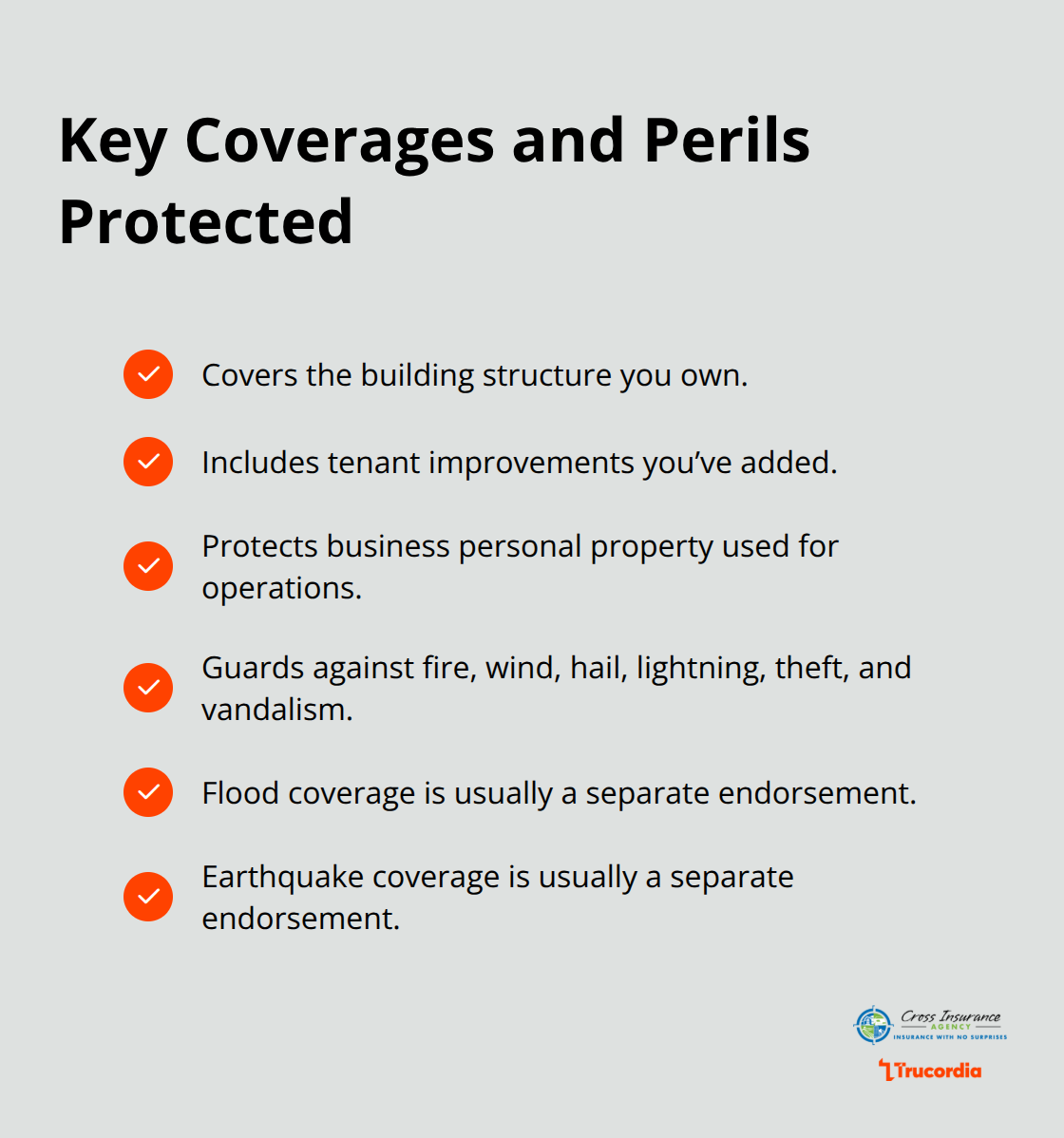
The coverage applies whether items are inside the building or outside, like signage and equipment stored on your property.
Income Protection During Downtime
Loss of income coverage is where many Washington businesses fall short. If a fire or major storm forces you to close for weeks or months, this coverage pays your regular business income while you rebuild. It also covers extra expenses you incur to keep operating-renting temporary space, expedited shipping for replacement equipment, or paying employees to work offsite. Without this protection, you lose revenue twice: once from the damage itself and again from the downtime.
Replacement Cost vs. Actual Cash Value
Replacement cost coverage is non-negotiable. It pays to rebuild or replace your assets with new materials without deducting depreciation, while actual cash value coverage deducts depreciation and often leaves you significantly underinsured. Construction costs in Washington have risen steadily, and equipment prices fluctuate, so your coverage limits need regular updates to match current replacement expenses. You should review your policy annually or whenever you add equipment, expand inventory, or make building improvements.
The specifics of what your policy covers depend on the form you select and the endorsements you add. Understanding these details now helps you avoid gaps that could expose your business to serious financial risk.
Why Washington Businesses Need Commercial Property Insurance
Washington’s natural environment and business landscape create real exposure that most owners underestimate. The Pacific Northwest experiences significant wind and hail damage annually, and coastal properties face storm surge risk. According to the National Oceanic and Atmospheric Administration, the U.S. sustained 403 weather and climate disasters from 1980–2024 where overall damages reached or exceeded $1 billion. Beyond weather, commercial properties attract theft and vandalism-retail spaces, construction sites, and equipment storage yards face constant risk. Fire damage remains one of the costliest perils; a single electrical fire or cooking accident destroys inventory, equipment, and the building itself within hours. Without commercial property insurance, you absorb these losses entirely from operating capital or savings. Most Washington business owners cannot recover from a major loss without coverage, and that financial exposure threatens not just the business but personal assets and employees’ livelihoods.
Lenders and Landlords Require Coverage
Financial institutions and landlords make commercial property insurance non-negotiable. If you financed your building, your lender requires proof of coverage before releasing funds and continues requiring it throughout your loan term. Landlords demand the same for tenant spaces-they protect their investment by mandating that you carry coverage for your improvements and contents. Many lease agreements specify minimum coverage limits and require the landlord as a named additional insured on your policy. Violating these requirements breaches your lease or loan documents and gives lenders grounds to cancel financing or landlords grounds to evict. Business owners often discover mid-claim that their coverage falls short of contractual requirements, leaving them personally liable for the gap. The practical step is straightforward: pull your lease and loan documents now, identify the coverage requirements, and confirm your current policy meets them exactly.
Uninsured Losses Devastate Cash Flow
Uninsured losses hit your bottom line immediately and hard. A restaurant fire that closes you for four months costs far more than rebuilding-you lose rent, employee wages, loan payments, and revenue simultaneously. A retail theft of 15,000 dollars in inventory damages your cash flow significantly if you self-insure. Equipment breakdown at a manufacturing facility idles your entire operation for weeks while you source replacement parts. These scenarios happen regularly in Washington businesses. The cost of commercial property insurance represents a small fraction of what one significant loss would cost. A typical small office pays 800 to 1,500 dollars annually for solid coverage, while a single fire loss averages 275,000 dollars in property damage according to the National Fire Protection Association.
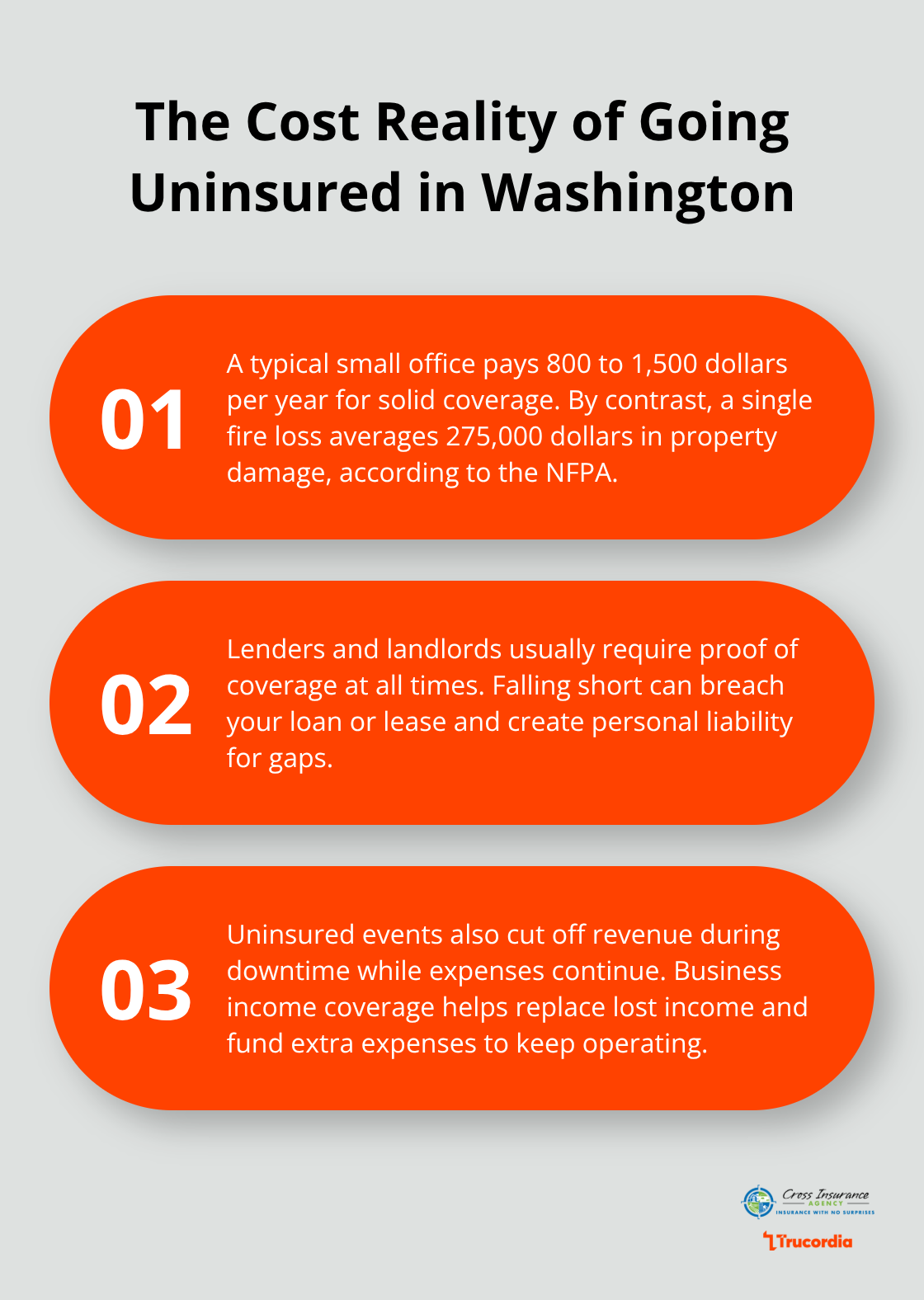
Coverage costs pennies compared to the financial catastrophe of an uninsured event.
Your Next Step: Assess Your Coverage Gaps
Business owners who skip or skimp on coverage are betting their business on luck, which is a terrible strategy. The question isn’t whether you can afford commercial property insurance-it’s whether you can afford not to have it. Your next move is to evaluate what your current policy actually covers and identify where gaps exist. This assessment sets the stage for choosing the right coverage limits and endorsements that match your specific business operations and asset values.
How to Choose the Right Commercial Property Insurance Policy
Document Your Assets With Precision
Start with a detailed inventory of what you own. Walk through your building and document every asset: the square footage and construction type of the structure itself, the age of the roof and major systems, equipment and machinery with purchase dates and current values, inventory stock levels, furniture and fixtures, outdoor signage and storage items. Write down replacement costs, not what you paid five years ago. A used desk might have cost 400 dollars, but replacing it today costs 600 dollars.
Commercial construction costs in Washington have climbed steadily. Your policy limits must reflect current replacement expenses, not historical purchase prices. Many business owners underestimate inventory value significantly. A retail clothing shop might carry 40,000 to 60,000 dollars in stock at any given time, but owners often insure for 25,000 dollars because they haven’t counted systematically.
Manufacturing operations frequently undervalue machinery and specialized tools. Schedule a time to photograph equipment, note serial numbers, and gather recent receipts or appraisals. This documentation serves two purposes: it gives your insurance agent accurate numbers and creates a claims record if loss occurs. Once you have this inventory, calculate the total replacement cost for your building structure, contents, and business improvements separately. This three-part breakdown reveals exactly where your exposure sits.
Compare Policies Across Multiple Carriers
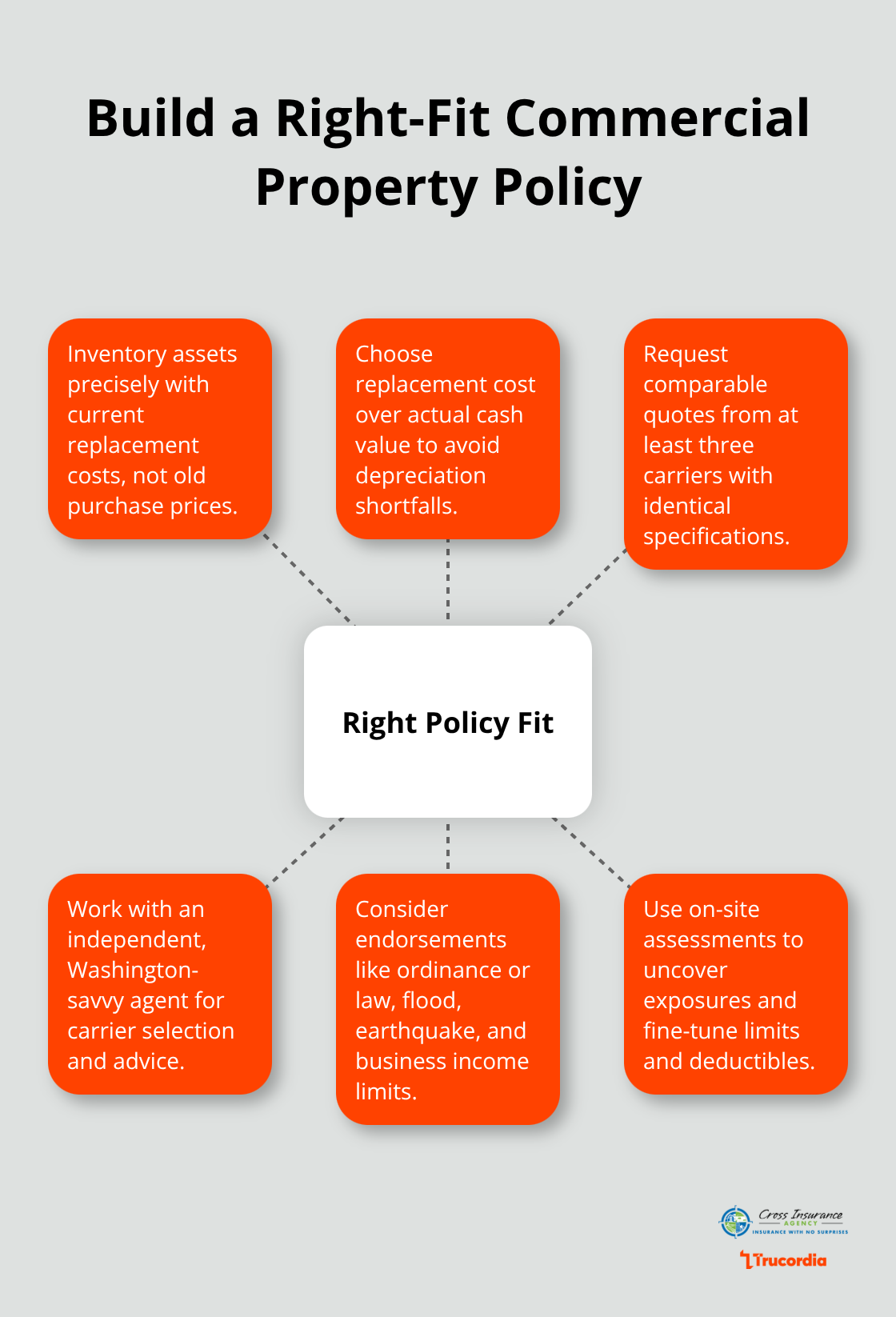
Comparing policies across carriers matters far more than most owners realize, but the comparison must be structured. Request quotes from at least three insurers using identical coverage specifications, limits, and deductibles so you see actual price differences rather than apples-to-oranges comparisons. Ask specifically about replacement cost versus actual cash value, whether ordinance and law coverage is included or optional, and what loss of income coverage limits are available.
A 500,000 dollar property limit with a 1,000 dollar deductible from one carrier might cost 1,200 dollars annually, while another charges 950 dollars for identical coverage. That 250-dollar difference compounds over years. However, price alone shouldn’t drive your decision. Examine each carrier’s claims process and response time. Look at whether the carrier offers risk assessment services; some insurers send engineers to identify exposures and recommend loss-prevention improvements that can reduce your premiums.
Work With Independent Agents Who Know Washington
Work with an independent agent who represents multiple carriers rather than captive agents tied to a single insurer. Independent agents shop multiple top-rated carriers to deliver genuine choice and competitive pricing tailored to your specific business and location. This approach reveals which insurers offer the best terms for your industry and risk profile. A contractor faces different underwriting considerations than a retail shop, and a coastal property faces different weather exposure than an inland location.
Local agents understand Washington’s specific risk landscape-the seismic activity in certain regions, flood patterns near rivers and Puget Sound, wind exposure on the coast, and crime rates in different neighborhoods. These factors directly influence both premium costs and available coverage options. An agent familiar with Washington commercial property insurance can advise whether your location warrants flood coverage as a priority or whether earthquake coverage makes sense given your property’s location. They can also identify endorsements that strengthen your protection without excessive cost.
Leverage On-Site Assessments
Request an on-site consultation if your business is complex or your asset values are substantial. A local agent can walk your property, spot exposures you’ve missed, and recommend specific coverage enhancements. This consultation costs nothing and often reveals gaps that save you money long-term by preventing underinsurance claims. The relationship with your agent becomes invaluable when a loss occurs and you need someone who understands your business and your policy intimately.
Final Thoughts
Commercial property insurance WA protects your business from financial devastation when loss strikes. The coverage you carry directly determines whether your business survives a major event or collapses under the weight of uninsured losses. A fire, theft, or storm can destroy years of investment in weeks, but the right policy transforms that catastrophic risk into a manageable expense.
Document what you own with precision, gather your lease and loan documents to identify coverage requirements, and request quotes from multiple carriers using identical specifications so you see genuine price differences. Work with an independent agent who represents several top-rated insurers and understands Washington’s specific risk landscape, from coastal storm exposure to seismic activity in certain regions. The cost of commercial property insurance is negligible compared to the financial catastrophe of an uninsured loss-a typical small office pays 800 to 1,500 dollars annually for solid coverage, while a single fire loss averages 275,000 dollars in property damage.
We at Cross Insurance Agency connect Washington business owners with tailored commercial property coverage that matches their specific assets and operations. Our licensed agents shop multiple carriers to deliver genuine choice, competitive pricing, and personalized guidance. Contact us today to review your coverage and get a quote that reflects your actual replacement costs and risk exposure.
Disclaimer: The information provided in this blog is for general informational purposes only and does not constitute legal, financial, or insurance advice. Coverage options, terms, and availability may vary. Please consult with a licensed professional for advice specific to your situation. Artificial intelligence may have been used to generate text and images in some blog articles.


