Vacation Rental Insurance WA: Guarding Your Short-Term Investment

Standard homeowners insurance won’t cover your vacation rental business. Most policies explicitly exclude short-term rental income and guest-related liability, leaving your investment exposed.
At Cross Insurance Agency, we see this gap repeatedly. Vacation rental insurance in WA fills those holes with coverage designed specifically for your rental operation.
Why Standard Homeowners Insurance Fails Vacation Rentals
Your Policy Excludes Rental Activity
Your standard homeowners policy treats your property as a primary residence, not a revenue-generating asset. The moment you list your property on Airbnb or VRBO, most major carriers will either cancel your coverage or deny claims related to rental activity. This isn’t theoretical-it’s how the insurance industry actually works. Homeowners policies exclude short-term rental income, guest injuries, and damage caused by transient occupants. If a guest slips on your stairs and sues for $50,000 in medical bills, your homeowners insurer will likely refuse to defend you because the injury occurred during a rental period. That gap between what you think you’re covered for and what you actually are covered for is where vacation rental owners in Washington face real financial exposure.
Short-Term Rentals Create Different Risk Profiles
Short-term rentals create risk profiles that standard homeowners policies simply don’t account for. Your property experiences constant turnover-new guests arrive every few days or weeks, which means more people move through your space, more opportunities for accidents, and higher wear-and-tear on furnishings and appliances. Furnished properties face significantly higher loss frequency than owner-occupied homes, particularly around theft, accidental damage, and liability claims. A guest who damages your kitchen during a week-long stay represents a different risk than a family living there permanently.
Income Loss and Liability Gaps
If your property sits vacant between bookings or if a major incident forces you to cancel reservations, you lose rental income-something your homeowners policy won’t replace. Vacation rental insurance in Washington specifically addresses these gaps with coverage for guest liability, loss of rental income during property damage, and protection against vandalism and theft of furnished contents. The liability exposure alone justifies making this switch. A single guest injury claim can reach tens of thousands of dollars, and without proper coverage, you’re personally liable for amounts far exceeding your homeowners policy limits.
These coverage gaps mean you need a policy built for your actual business model. The right vacation rental insurance protects both your property and your income stream-two things standard homeowners coverage simply cannot do.
What Coverage You Actually Need for Your Washington Rental
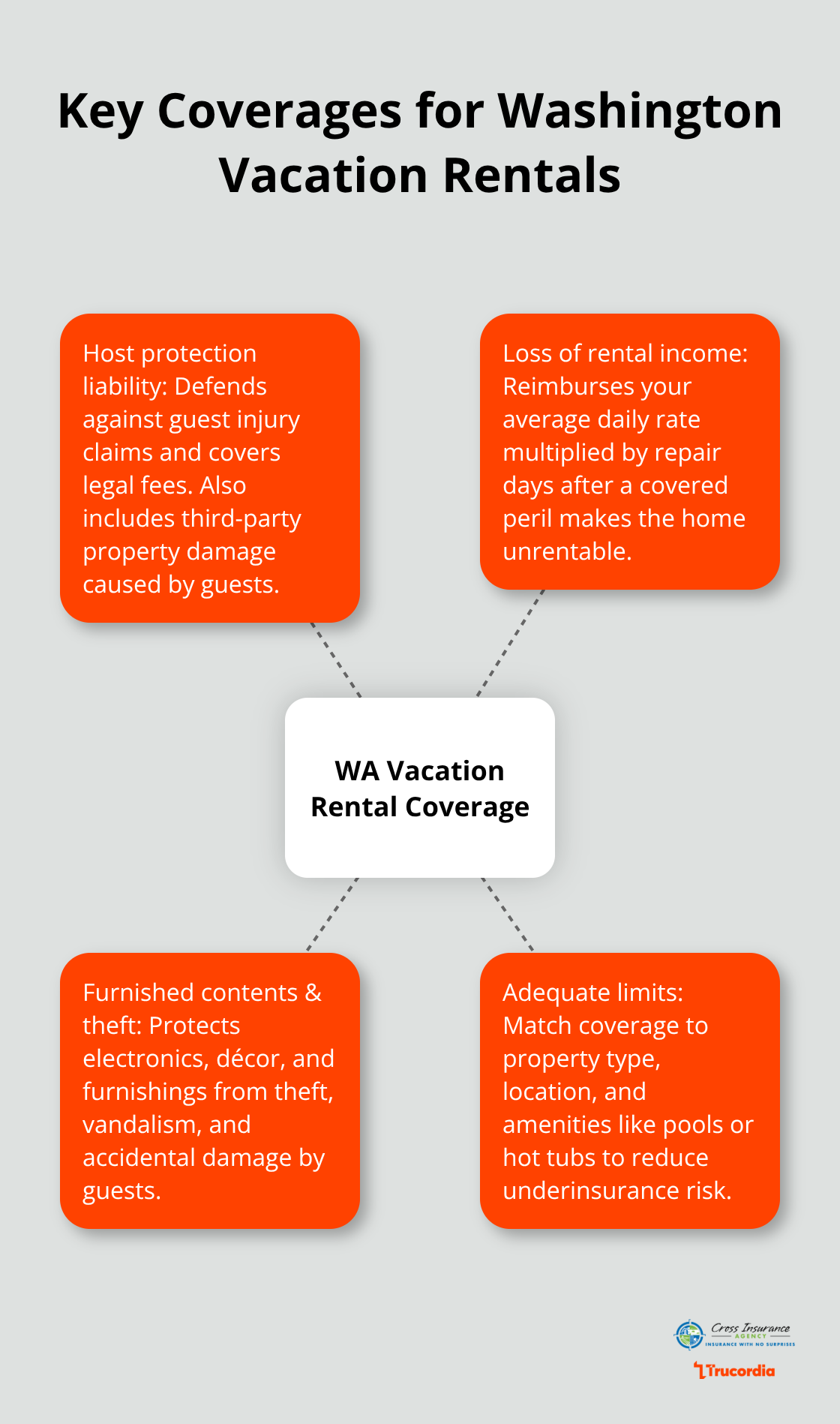
Host Protection Liability Shields You from Guest Injuries
Guest liability claims represent the most immediate financial threat to your vacation rental operation. When a visitor slips on wet flooring, suffers a fall from a balcony, or gets injured by a defective appliance, you face personal liability that extends far beyond typical homeowners coverage limits. A serious injury claim can easily reach $100,000 or more in medical expenses, lost wages, and pain-and-suffering damages.
Vacation rental insurance in Washington provides host protection liability specifically designed to defend you against these guest-related claims and cover legal fees if litigation occurs. This coverage typically includes bodily injury liability for guests and third parties, as well as property damage liability if a guest accidentally damages a neighboring unit or someone else’s belongings.
The liability limit matters tremendously. Most Washington properties need minimum coverage of $300,000 to $500,000, though high-value homes or those with swimming pools warrant $1,000,000 or higher. Standard policies cap liability at $300,000 to $500,000, which leaves you dramatically underprotected once rental activity begins.
Loss of Rental Income Coverage Protects Your Cash Flow
Loss of rental income coverage protects your cash flow when your property becomes temporarily uninhabitable due to a covered loss. A kitchen fire, severe water damage from burst pipes, or damage from a severe storm could force you to cancel bookings for weeks or months. Without this coverage, you absorb the full financial impact-potentially thousands of dollars per week in lost reservation income.
This coverage reimburses you for lost rental income during the repair period, typically up to your average daily rental rate multiplied by the number of days needed for repairs. The protection activates when a covered peril makes your property unrentable, ensuring your business survives unexpected disruptions.
Furnished Contents and Theft Protection Address High-Risk Losses
Furnished properties face elevated theft and vandalism risks compared to owner-occupied homes. Guest turnover creates opportunities for theft of electronics, artwork, and high-value furnishings, while careless guests or intentional damage can destroy your décor and fixtures. Vacation rental insurance includes specific protection for furnished contents and theft coverage tailored to short-term rental environments.
Document your property’s contents with photos and estimated values to establish adequate coverage limits. Most insurers allow coverage limits between $10,000 and $50,000 for furnished contents depending on your property’s quality and amenities. This documentation becomes essential if you file a claim, as it proves what you owned and its replacement cost.
Selecting the Right Coverage Limits for Your Property
Your property type, location, and guest volume all influence the coverage limits you need. A modest two-bedroom cottage in a rural area requires different protection than a luxury waterfront home in a popular tourist destination. Properties with pools, hot tubs, or other attractive nuisances warrant higher liability limits because they increase injury risk significantly.
The next step involves comparing how different carriers structure their policies and what endorsements they offer to fill remaining gaps in your protection.
How to Choose the Right Vacation Rental Insurance Policy
Your property type, rental frequency, and guest volume determine which policy structure makes sense for your situation. A three-bedroom home rented 200 nights per year operates under different risk conditions than a studio apartment rented year-round, and your insurance needs to reflect that distinction. Start by calculating your actual rental days annually-this number directly influences both your premium and the coverage options available to you. Properties rented fewer than 90 days per year sometimes qualify for standard homeowners policies with short-term rental endorsements, which cost significantly less than dedicated vacation rental policies. Properties rented more than 180 days annually almost always require full vacation rental coverage because the risk profile shifts from occasional rental to primary business operation.
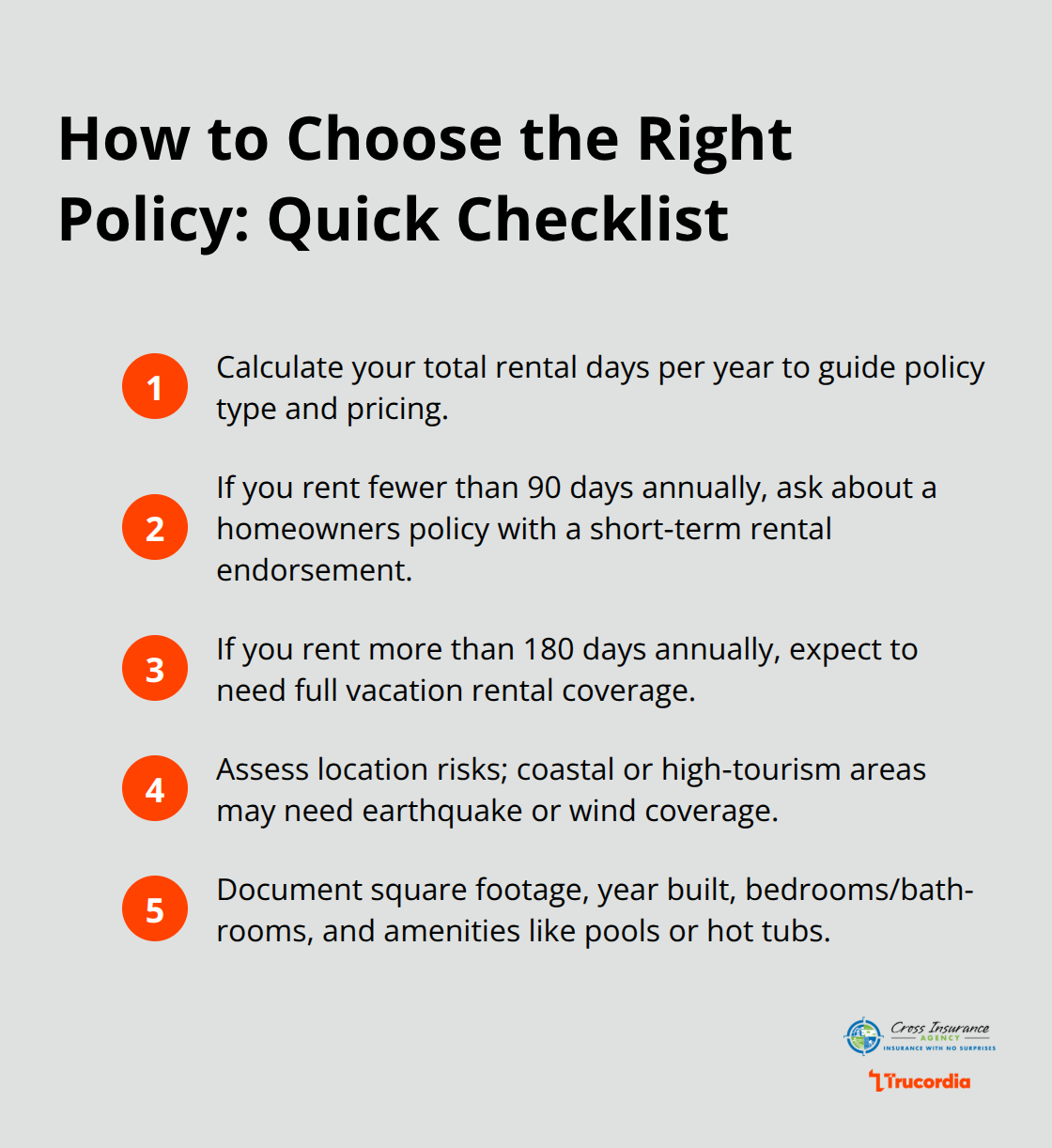
Your property location matters equally. A beachfront home in a high-tourism area faces different theft and liability exposure than an inland property, and coastal properties require separate earthquake or wind coverage depending on their specific geographic risk. Document your property’s square footage, construction year, number of bedrooms and bathrooms, and any special features like pools or hot tubs-carriers use this information to calculate accurate premiums and appropriate liability limits.
Coverage Limits Must Match Your Actual Exposure
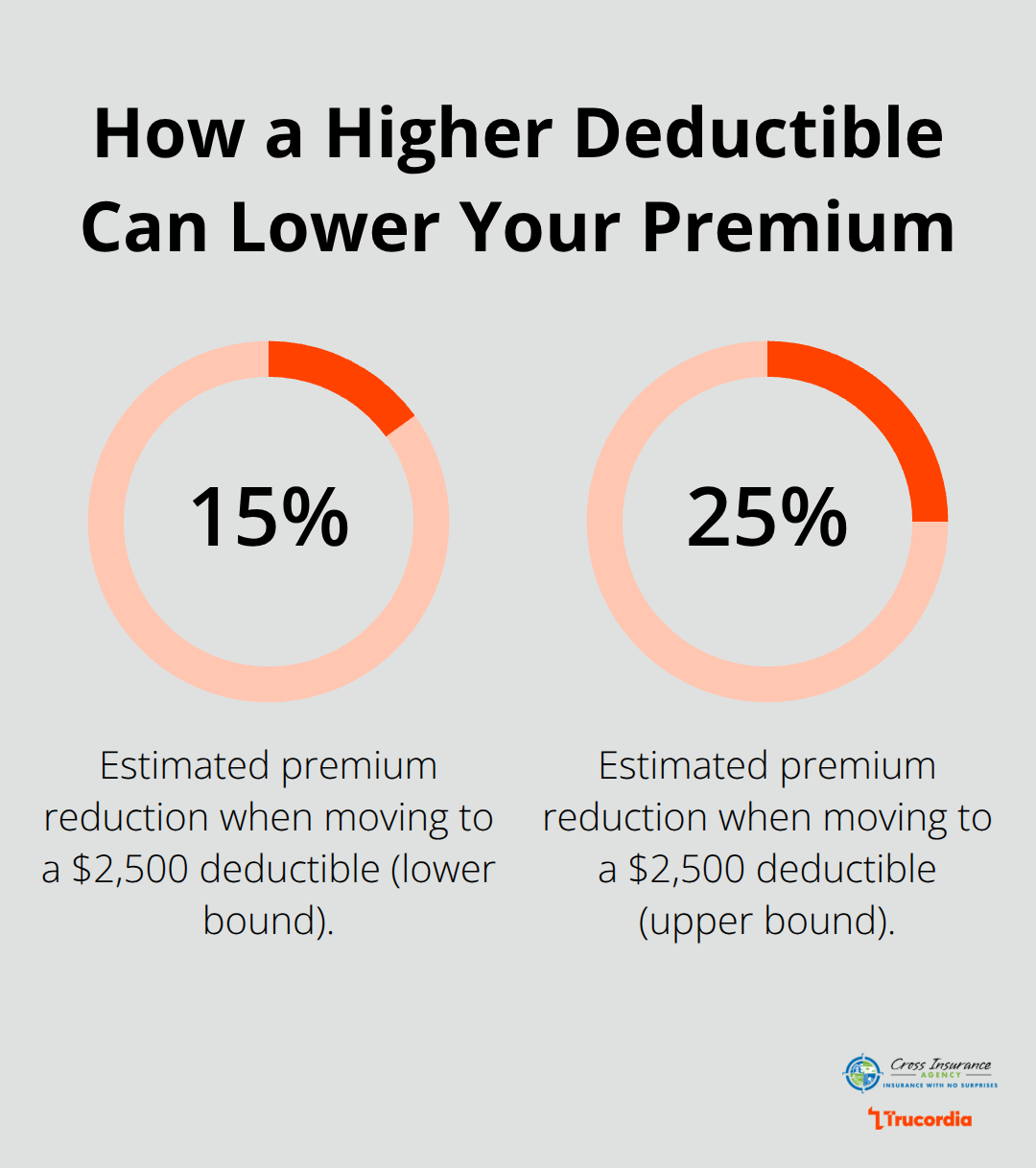
Standard vacation rental policies typically offer liability coverage starting at $300,000, but this number represents a floor, not a recommendation. A serious guest injury claim routinely exceeds this amount-medical expenses alone for a spinal cord injury or permanent disability can reach $500,000 to $1,000,000. Most Washington properties need minimum $500,000 liability coverage, with $1,000,000 limits for homes with pools, hot tubs, or properties in high-traffic tourist areas. Your deductible choice directly affects your premium-selecting a $2,500 deductible instead of $500 can reduce your annual premium by 15 to 25 percent, but you must have that cash available when a loss occurs. Most owners benefit from choosing the highest deductible they can comfortably cover out of pocket, since frequent small claims rarely happen in vacation rentals.
For loss of rental income coverage, calculate your average nightly rate and multiply it by the typical repair timeline for common disasters in your area-water damage repairs typically require 30 to 60 days, so coverage should reimburse at least 60 days of lost income. Furnished contents coverage should equal your actual replacement cost for all furnishings, electronics, and décor-underestimating this amount leaves you personally liable for replacement costs exceeding your policy limits.
Specialized Carriers Understand Short-Term Rental Risk Better Than Generalists
Not all insurance carriers treat vacation rentals equally. Standard homeowners insurers either exclude vacation rentals entirely or price them at punitive rates because they lack specific underwriting expertise. Carriers specializing in short-term rentals employ underwriters who understand guest turnover, seasonal occupancy patterns, and the specific loss history of furnished properties. These specialists typically offer broader coverage options, more flexible endorsements, and faster claims processing than traditional carriers. When evaluating carriers, ask specifically about their claims response time for vacation rental properties-a 24-hour initial response and same-day adjuster assignment matters when you lose rental income daily. Request sample policies from at least three carriers and compare not just the premium but the actual coverage terms, exclusions, and endorsement costs. Some carriers bundle crime coverage and cyber liability at reasonable rates, while others charge significant add-on fees for protection against guest data theft or payment processor fraud. Verify that any carrier you consider has A.M. Best financial ratings of A or higher, confirming they can actually pay claims if a major loss occurs. Ask about loss-mitigation credits-many carriers reduce premiums 10 to 20 percent if you install security systems, fire extinguishers, or implement guest screening procedures that reduce claim frequency.
Final Thoughts
Vacation rental insurance in WA protects your investment against three critical threats that standard homeowners policies ignore: guest liability claims that reach $100,000 or more, loss of rental income during property repairs, and theft or vandalism of furnished contents. A single serious injury claim or major property damage event can eliminate years of rental profits if you lack proper protection. The coverage gaps are real, and they cost money when claims happen.
Specialized vacation rental insurers understand your actual risk profile far better than traditional homeowners carriers. They process claims faster because they handle vacation rentals constantly, they offer endorsements designed specifically for short-term rental operations, and they provide loss-mitigation credits that reward you for implementing safety measures. When you compare carriers, focus on claims response time, financial stability ratings, and whether they offer discounts for security systems or guest screening procedures.
We at Cross Insurance Agency work with multiple top-rated carriers to find vacation rental coverage that matches your specific property and rental operation. Our licensed agents shop the market on your behalf, compare actual policy terms and exclusions, and help you select coverage limits that protect your investment without overpaying. Contact us to discuss your vacation rental insurance needs and get quotes from carriers that specialize in Washington short-term rentals.
Disclaimer: The information provided in this blog is for general informational purposes only and does not constitute legal, financial, or insurance advice. Coverage options, terms, and availability may vary. Please consult with a licensed professional for advice specific to your situation. Artificial intelligence may have been used to generate text and images in some blog articles.


