
Rental Property Insurance WA: Protect Your Investment With Local Coverage
Owning rental property in Washington comes with real financial risk. Your standard homeowners policy won’t cover tenant-related losses or liability claims that landlords face every day.
At Cross Insurance Agency, we help Washington landlords build rental property insurance WA policies that actually protect their investment. This guide walks you through the coverage types you need, how to spot gaps in your protection, and how to choose the right policy for your specific situation.
What Landlords Actually Face in Washington
Washington’s Legal Requirements for Landlords
Washington State doesn’t mandate landlord insurance by law, but your mortgage lender almost certainly does-most require it as a condition of financing. Washington’s Residential Tenancy Act gives tenants substantial legal protections, which means your liability exposure is real and significant. The state allows tenants to withhold rent for uninhabitable conditions, file complaints with local housing authorities, and pursue damages through small claims court or civil lawsuits. A single liability claim from a tenant injury can easily exceed $100,000, and your standard homeowners policy explicitly excludes rental properties.
Why Your Homeowners Policy Fails You
Your homeowners insurance is designed for owner-occupied properties only. It won’t cover liability claims from tenants, damage caused by tenants, or income loss when a tenant stops paying rent. If a tenant is injured on your property and sues, your homeowners insurer can deny the entire claim because the property generates income. Rental property insurance fills these gaps by covering tenant-caused damage, loss of rent during disputes or extended vacancies, and liability specific to landlord situations. It also covers landlord-specific perils like malicious damage beyond normal wear and tear. The cost difference is modest-rental property insurance typically runs 15-25% more than standard homeowners coverage but protects against losses that could bankrupt an unprepared landlord.
Three Coverage Gaps That Hurt Most
Landlords commonly face three major protection failures. First, they lack loss of rent coverage, which means if a tenant damages the property and you must evict them, you absorb months of lost income while repairs happen. An eviction in Washington takes 30-90 days minimum, and during that time your mortgage, taxes, and maintenance bills don’t pause. Second, they underestimate liability exposure-a tenant slip-and-fall, a guest injury on the property, or a code violation injury can trigger claims exceeding their policy limits. Third, they don’t cover tenant-caused damage adequately, assuming their security deposit covers everything.
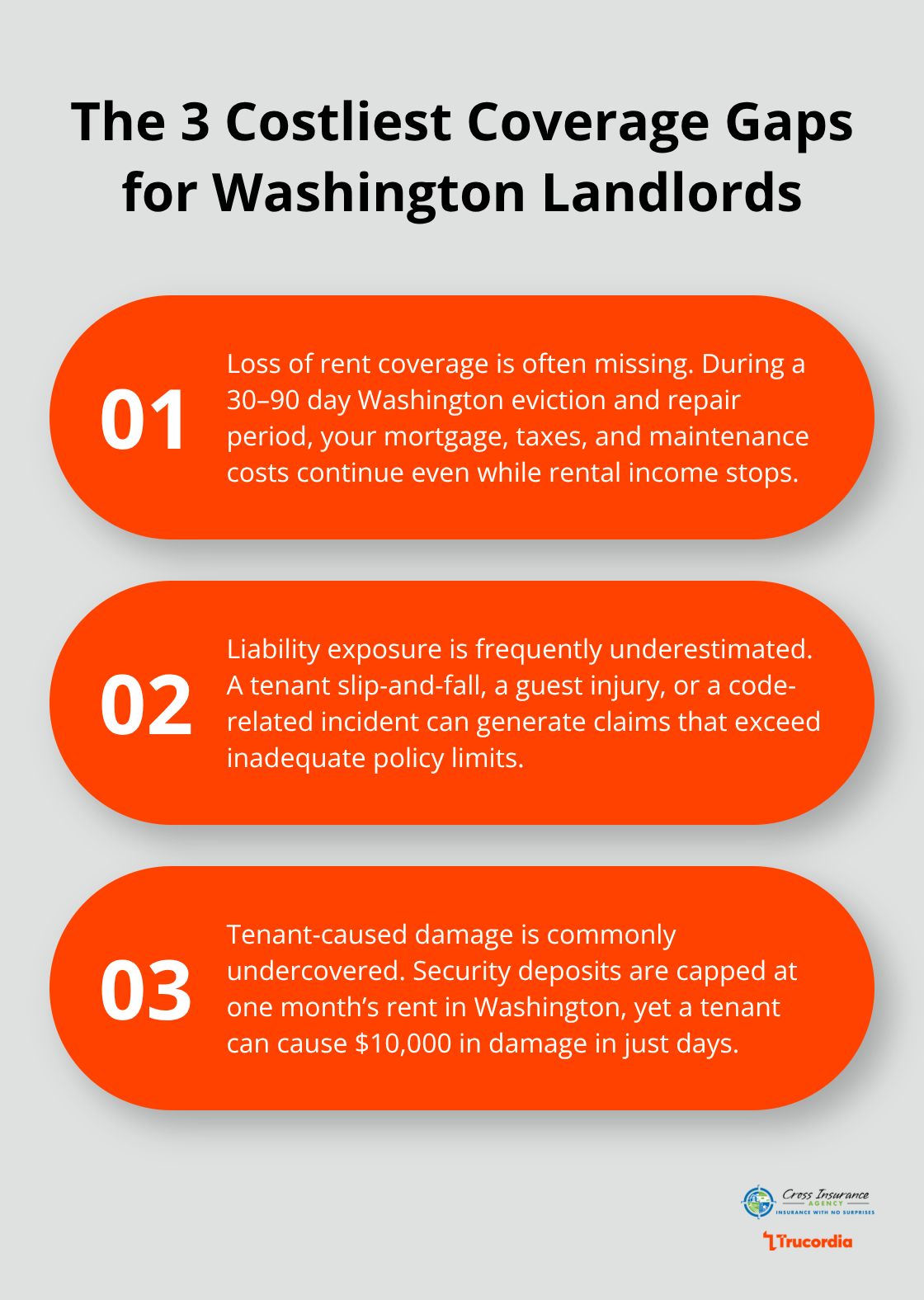
Security deposits in Washington are capped at one month’s rent, but a tenant can cause $10,000 in damage in days. Proper rental property insurance covers these scenarios with specific protections that homeowners policies simply don’t address.
What Rental Property Insurance Actually Covers
The right rental property insurance policy protects you against the specific risks that come with tenant-occupied properties. Building and structure protection covers damage to the physical property from fire, theft, vandalism, and weather events. Liability coverage protects you when a tenant or their guest is injured on your property and files a claim against you. Loss of rent coverage replaces your income during evictions, extended vacancies, or when the property becomes temporarily uninhabitable.
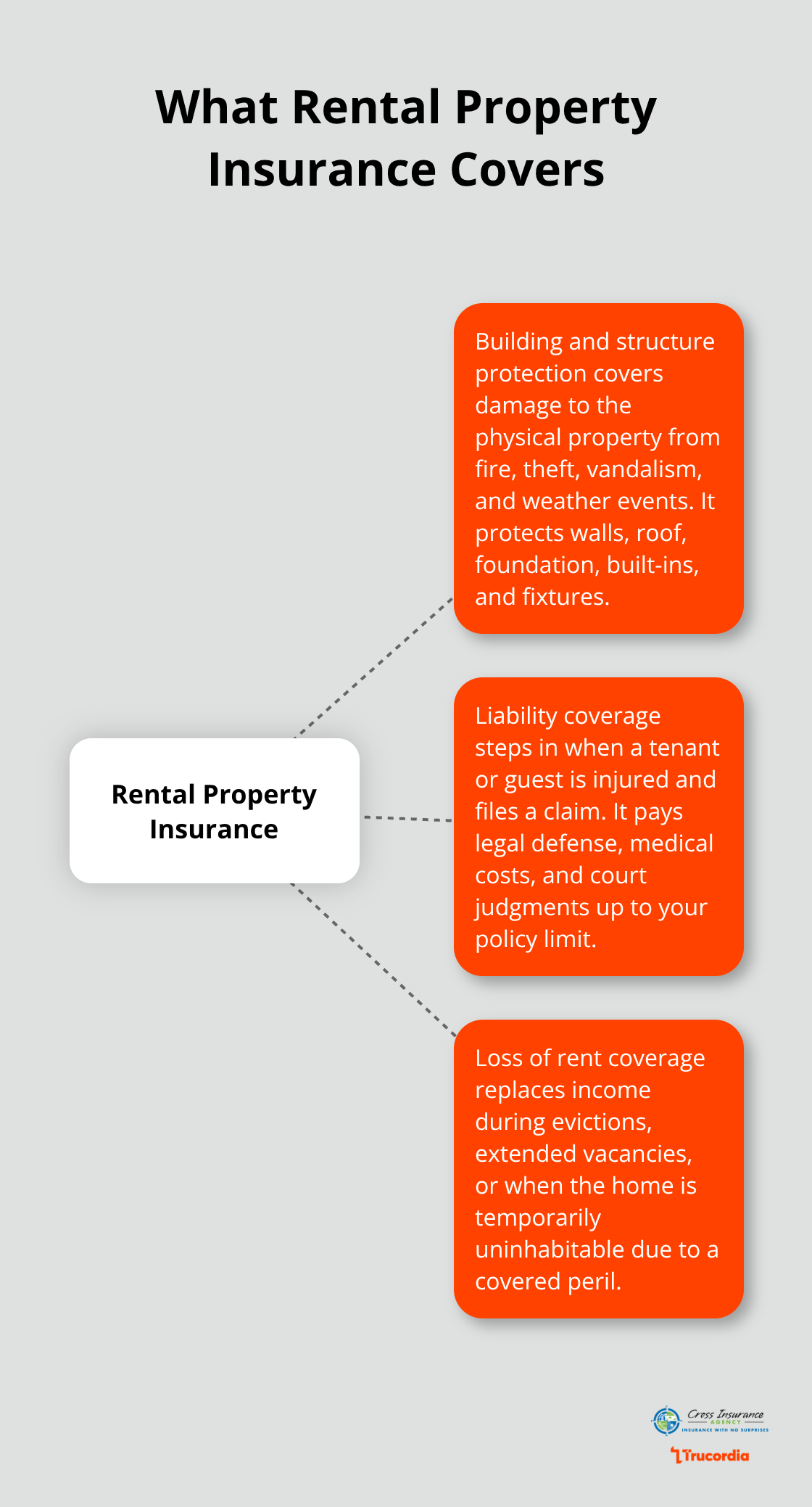
These three components work together to address the gaps that leave unprepared landlords exposed. Understanding what each type of coverage does helps you make informed decisions about your protection level and policy limits.
Essential Coverage Types for Your Washington Rental Property
Building and Structure Protection
Building and structure protection covers the physical property itself-the walls, roof, foundation, built-in appliances, and permanent fixtures. This protection applies to damage from fire, theft, vandalism, weather events, and other named perils, depending on your policy form. In Washington, where winter storms and heavy rain are common, this coverage matters significantly.
You must insure the property for its full replacement cost, not just the current market value. Many landlords underestimate replacement costs and end up underinsured. A professional property appraisal or reconstruction estimate from a contractor determines the actual replacement value accurately. Don’t rely on what you paid for the property years ago-construction costs have risen substantially.
If your property costs $400,000 to replace but you only insure it for $300,000, your insurer will pay claims proportionally, leaving you responsible for the gap. This is called coinsurance, and it’s a costly mistake. Try insuring to at least 100% of replacement cost, and some landlords benefit from extended replacement cost coverage that pays up to 125% if reconstruction costs exceed estimates.
Liability Coverage for Tenant-Related Claims
Liability coverage protects you when a tenant, tenant’s guest, or even a trespasser is injured on your property and sues you for damages. Washington courts have awarded substantial judgments in landlord liability cases-slip-and-fall claims frequently exceed $50,000, and serious injuries can reach $200,000 or more. Your liability coverage pays legal defense costs, medical expenses, and court judgments up to your policy limit.
Standard limits start at $300,000, but many landlords carrying multiple properties or properties in higher-risk areas need $500,000 to $1,000,000 in protection. The right limit depends on your property type, location, and tenant profile. A single serious injury claim can wipe out years of rental income, making adequate liability limits non-negotiable.
Loss of Rent Coverage During Evictions and Repairs
Loss of rent coverage replaces your monthly income during specific situations: when a tenant damages the property and you must evict them while repairs happen, when the property becomes uninhabitable due to a covered peril, or during extended vacancies you couldn’t have prevented. Washington evictions take 30 to 90 days minimum, and during that time your mortgage, property taxes, insurance, and maintenance costs continue.
Loss of rent coverage typically reimburses 30 days of lost rent per claim, though you can purchase extended periods if needed. If your property rents for $2,000 monthly, a 60-day eviction and repair cycle means $4,000 in lost income you’d otherwise absorb alone. This coverage is inexpensive relative to the protection it provides, usually adding only $15 to $40 monthly to your premium.
Understanding these three coverage types helps you move forward with confidence when selecting your policy limits and protection level. The next step involves assessing your specific property value and risk factors to determine exactly how much coverage you actually need.
How to Choose the Right Rental Property Insurance Policy
Calculate Your True Replacement Cost
Start with an honest assessment of what your property would actually cost to rebuild from scratch. This number determines your entire protection strategy, and most landlords get it wrong by relying on outdated valuations or guesswork. Contact a local contractor in Washington and request a detailed reconstruction estimate that accounts for current labor costs, materials, and local building codes. Replace your property’s value based on actual reconstruction costs-this means determining what it would cost to rebuild your home at today’s construction prices, rather than relying on market value.
Many landlords overlook additional structures like detached garages, storage sheds, or fences-these add to your replacement cost and need separate coverage. Once you have the reconstruction estimate, add 10-15% as a buffer for cost inflation and unexpected complications during rebuilding. This gives you a realistic insurance-to-value ratio that prevents coinsurance penalties when you file a claim.
Evaluate Your Property’s Risk Profile
Your property’s specific risk profile shapes which coverage options matter most. A single-family home in a quiet neighborhood has different exposure than a multi-unit building in an urban area or a property with a history of tenant turnover. Walk through your property and document condition issues-deferred maintenance, outdated electrical systems, older roofing, or problematic drainage all increase claim frequency and affect your premium.
Properties with previous water damage or theft claims will face higher rates or coverage restrictions. Request quotes from at least three carriers because rates for identical coverage vary significantly based on each insurer’s appetite for your specific risk profile. One carrier might specialize in older homes and offer competitive rates while another charges substantially more.
Compare Quotes Accurately
When comparing quotes, verify that all three include identical coverage limits, deductibles, and protection types-comparing a $500 deductible quote against a $1,000 deductible quote tells you nothing about actual value. Document your property’s square footage, construction type, year built, roof condition, and any recent upgrades or repairs, as these details directly impact pricing across carriers.
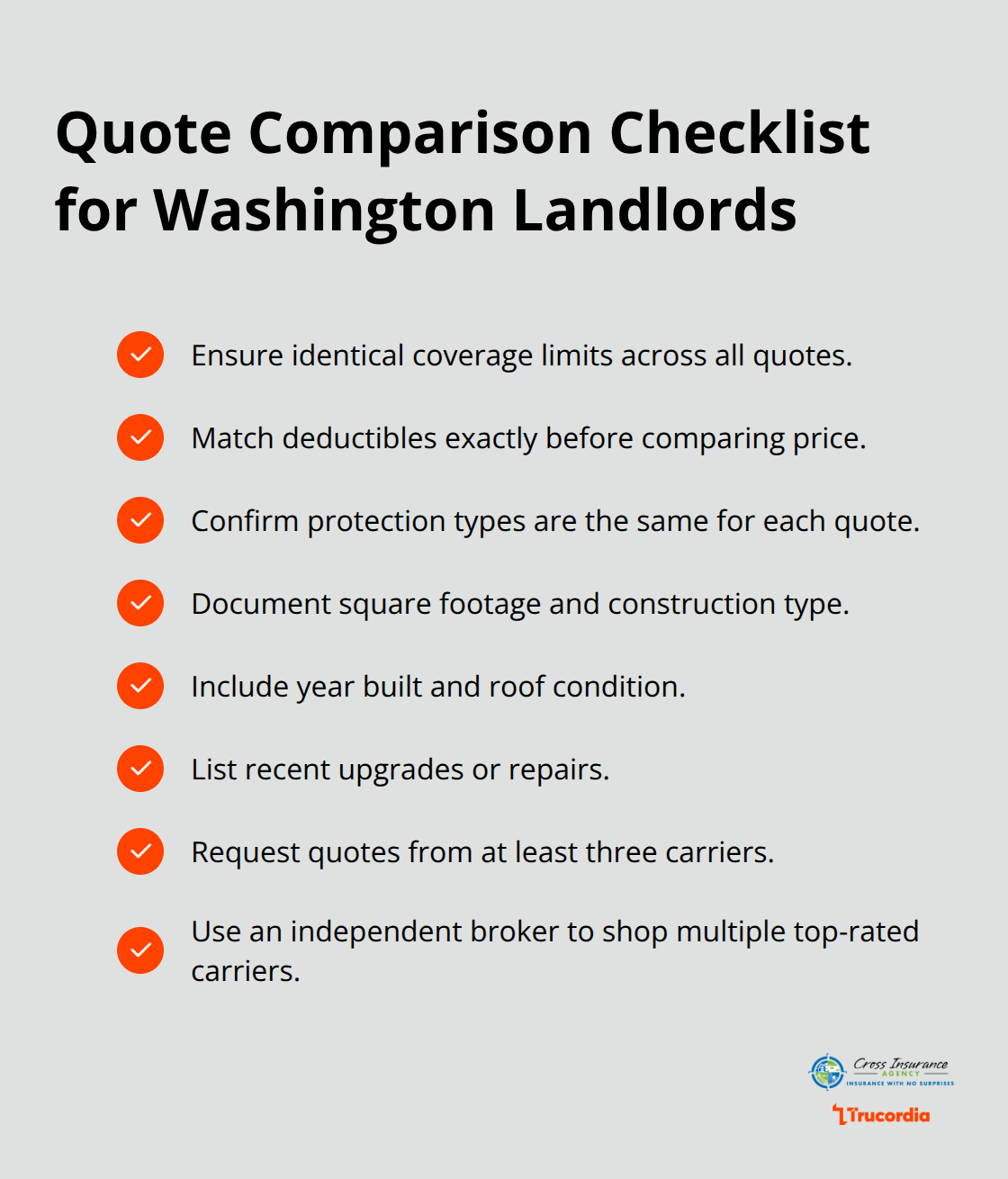
An independent insurance broker shops multiple top-rated carriers for each client, which reveals pricing variations and prevents you from overpaying for the same protection.
Work With a Local Agent Who Specializes in Landlords
Not all insurance agents understand landlord-specific risks or Washington’s tenant laws. An agent who specializes in rental properties knows which carriers offer competitive rates for loss of rent coverage, which ones provide adequate liability limits for multi-unit properties, and how to structure coverage that actually works when you need to file a claim.
Interview potential agents and ask specifically about their experience with Washington eviction timelines, tenant damage claims, and liability disputes. A strong local agent provides claims advocacy when something goes wrong-they understand your policy language, know which carriers handle claims efficiently, and push back when an insurer tries to deny a legitimate claim. This advocacy saves money and stress during the worst moments of property ownership.
Final Thoughts
Rental property insurance WA protects your income, your assets, and your peace of mind when tenant disputes or property damage strike. The three coverage types we’ve covered-building protection, liability coverage, and loss of rent-address the specific risks that homeowners policies ignore completely. Without them, a single tenant injury claim or property damage incident can eliminate years of rental income and force you into financial hardship.
Your next step is straightforward: get your property professionally appraised for replacement cost, document its current condition, and request quotes from multiple carriers. Rates vary significantly between insurers, and the cheapest option often leaves dangerous gaps in your protection (a $50 monthly premium difference compounds to $600 annually). Washington’s tenant laws give renters substantial protections, which means your liability exposure is real and demands adequate coverage limits.
Contact our team at Cross Insurance Agency to get quotes tailored to your specific rental property and situation. Our licensed agents shop multiple top-rated carriers to find coverage that actually fits your property and your budget. We handle the comparison work, explain what each policy covers, and provide claims advocacy when you need it most.
Disclaimer: The information provided in this blog is for general informational purposes only and does not constitute legal, financial, or insurance advice. Coverage options, terms, and availability may vary. Please consult with a licensed professional for advice specific to your situation. Artificial intelligence may have been used to generate text and images in some blog articles.


