
Renters Umbrella Policy WA: Extra Liability Protection for Tenants

Your standard renters insurance policy has limits. Once you exceed those limits after an accident or injury on your rental property, you’re personally responsible for the rest.
A renters umbrella policy in WA fills that gap by providing additional liability coverage when your base policy maxes out. At Cross Insurance Agency, we see tenants underestimate their exposure to serious claims all the time.
This guide walks you through what umbrella coverage actually protects, why Washington renters need it, and how to get the right limits for your situation.
How Umbrella Coverage Works Beyond Your Base Policy
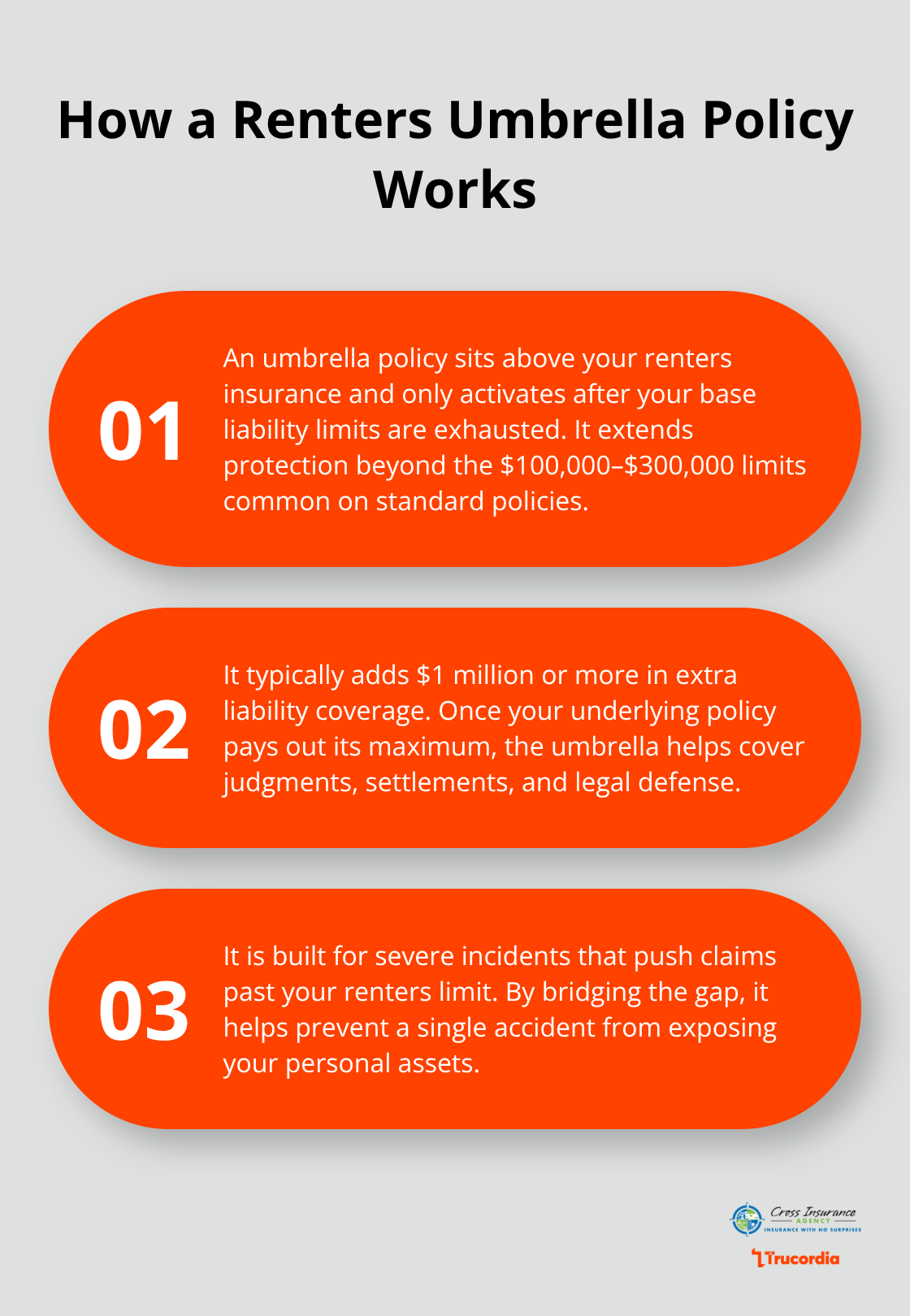
An umbrella policy sits on top of your renters insurance and activates only when your base coverage limits are exhausted. Your standard renters policy typically covers liability up to $100,000 or $300,000 depending on what you selected. Once you hit that ceiling after a serious accident or injury claim, the umbrella kicks in and provides an additional layer of protection-commonly $1 million or more.
One slip-and-fall incident with multiple injuries or significant property damage can easily push claims past a $300,000 threshold. Medical expenses alone accumulate fast: a single hospital stay combined with ongoing physical therapy and lost wages for an injured guest can exceed standard coverage in weeks. The umbrella policy covers the gap between what your renters insurance pays out and what the injured party receives in a judgment or settlement.
What Umbrella Coverage Actually Protects
Your umbrella policy covers the same types of liability your renters insurance does-bodily injury to someone on your rental property, property damage you cause to a neighbor’s home or belongings, and legal defense costs. If a guest slips on your kitchen floor and suffers a serious back injury, or if you accidentally damage your landlord’s walls during a party, umbrella coverage steps in once your base limits run dry.
The umbrella also covers some incidents your base renters policy might exclude or limit, though you should always verify the exact terms with your agent.
One critical difference: umbrella policies require that you maintain minimum liability limits on your underlying renters insurance-usually at least $300,000-before the umbrella will pay anything. You cannot purchase umbrella coverage in isolation; it depends entirely on your base renters policy being in place and active.
Renters Insurance Versus Umbrella Protection
Renters insurance and umbrella coverage serve different functions, and most Washington tenants need both. Your renters policy covers your personal belongings inside the rental unit (furniture, electronics, clothing) plus provides that baseline liability protection. An umbrella policy never covers your belongings; it only adds extra liability protection when your base policy limits are maxed out.
Think of renters insurance as your foundation and umbrella as your reinforcement. The cost difference is substantial: renters insurance in Washington averages around $15 to $25 monthly, while umbrella coverage typically runs $100 to $300 annually for $1 million in additional limits.
Many tenants assume their renters policy is enough because they focus on the personal property coverage, but they overlook how quickly liability claims escalate. A dog bite, a guest injury, or accidental damage to the rental unit itself can generate legal fees and medical costs that demolish standard coverage limits within days. Bundling renters and umbrella policies through one agent often unlocks discounts that reduce the total cost of both, making the extra protection affordable.
Why Your Liability Exposure Matters More Than You Think
A single serious incident can expose you to financial ruin if your coverage stops short. The gap between your base policy limit and a real-world judgment is where your personal assets become vulnerable. Understanding this gap is the first step toward protecting yourself-and it’s exactly what the next section addresses as we look at the specific liability risks Washington renters face.
Why Washington Renters Face Real Liability Exposure
The True Cost of a Single Claim
Washington renters underestimate their exposure to serious liability claims because they assume worst-case scenarios happen to other people. They don’t. A guest fractures their ankle on your apartment stairs and sues. Medical bills plus lost wages quickly climb to $250,000. Your standard renters policy maxes out. You now face personal liability for everything above that threshold, and Washington courts award substantial damages.
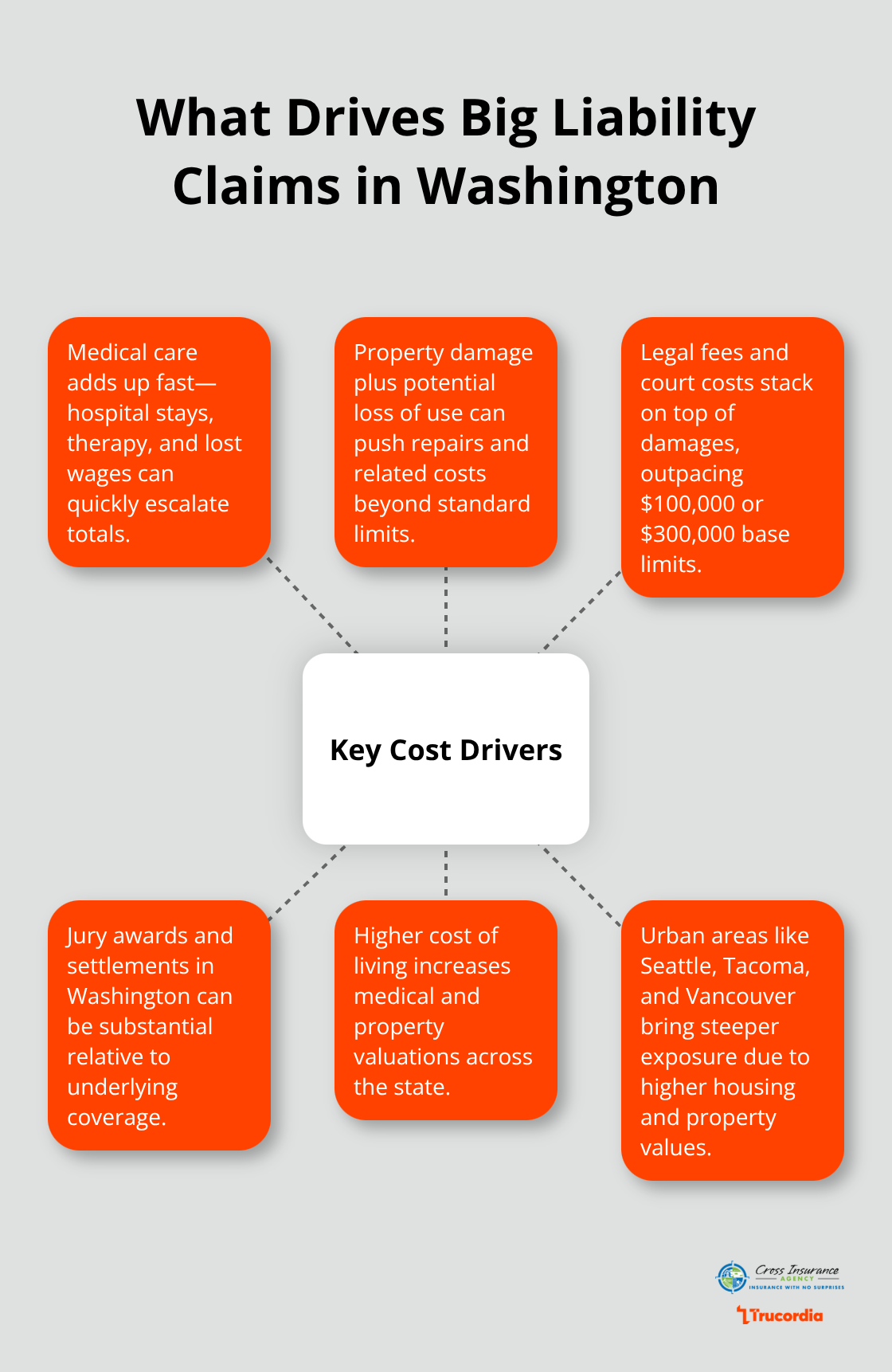
A single incident-a dog bite requiring reconstructive surgery, a party guest injured in a fall, water damage you cause to a neighbor’s unit-generates medical expenses, legal fees, and settlement costs that demolish $100,000 or $300,000 limits in weeks.
How Quickly Property Damage Claims Escalate
Property damage claims escalate just as fast as injury claims. If you accidentally damage your landlord’s walls during a move or a guest spills wine on expensive flooring, repair costs combined with liability for the landlord’s lost rental income during repairs easily exceed standard coverage. Washington’s higher cost of living means medical care and property values drive claim amounts higher than the national average. Renters in Seattle, Tacoma, and Vancouver face even steeper exposure because housing costs and associated property values inflate damage assessments.
The Gap Between Coverage and Reality
Standard renters insurance was designed decades ago when liability claims averaged far less. Today’s medical costs, legal fees, and jury awards have outpaced those old limits. A serious claim doesn’t require a catastrophic accident-it requires one guest injury, one property damage incident, or one liability lawsuit that your base policy cannot fully cover. Washington renters who carry only standard renters insurance gamble that they’ll never face a claim large enough to expose their personal assets. Tenants with umbrella coverage eliminate that gamble entirely.
The Real Price of Protection
The cost of umbrella coverage is modest: policies run $100 to $300 yearly for $1 million in additional limits, yet they protect everything you own from judgment creditors. Without that protection, a single claim triggers wage garnishment, asset seizure, and years of financial recovery. Washington renters who work hard to build savings and own vehicles or investments cannot afford to skip this layer of protection. What separates renters who stay protected from those who face financial devastation is whether they acknowledge this gap exists and take action to close it. The next section shows you exactly how to assess your own liability exposure and determine what coverage limits make sense for your situation.
Getting the Right Umbrella Coverage for Your Situation
Calculate Your Actual Liability Exposure
Start by calculating what you actually own and what a serious claim could cost you. Most Washington renters focus only on their renters insurance deductible and forget that liability exposure extends far beyond that. If someone sues you after an injury on your rental property, they’re not just claiming medical bills-they’re claiming lost wages, pain and suffering, and punitive damages in cases of gross negligence. A jury in King County or Pierce County can award six figures easily. Add legal defense costs (which umbrella policies cover) and you’re looking at totals that shred a $300,000 limit.
What are your monthly earnings? What assets do you own-savings, a vehicle, investments? What’s your net worth? That number determines your minimum umbrella limit. If you earn $4,000 monthly and have $50,000 in savings plus a vehicle worth $15,000, you need enough coverage to protect that $65,000 base plus future earnings.
Determine Your Umbrella Limit
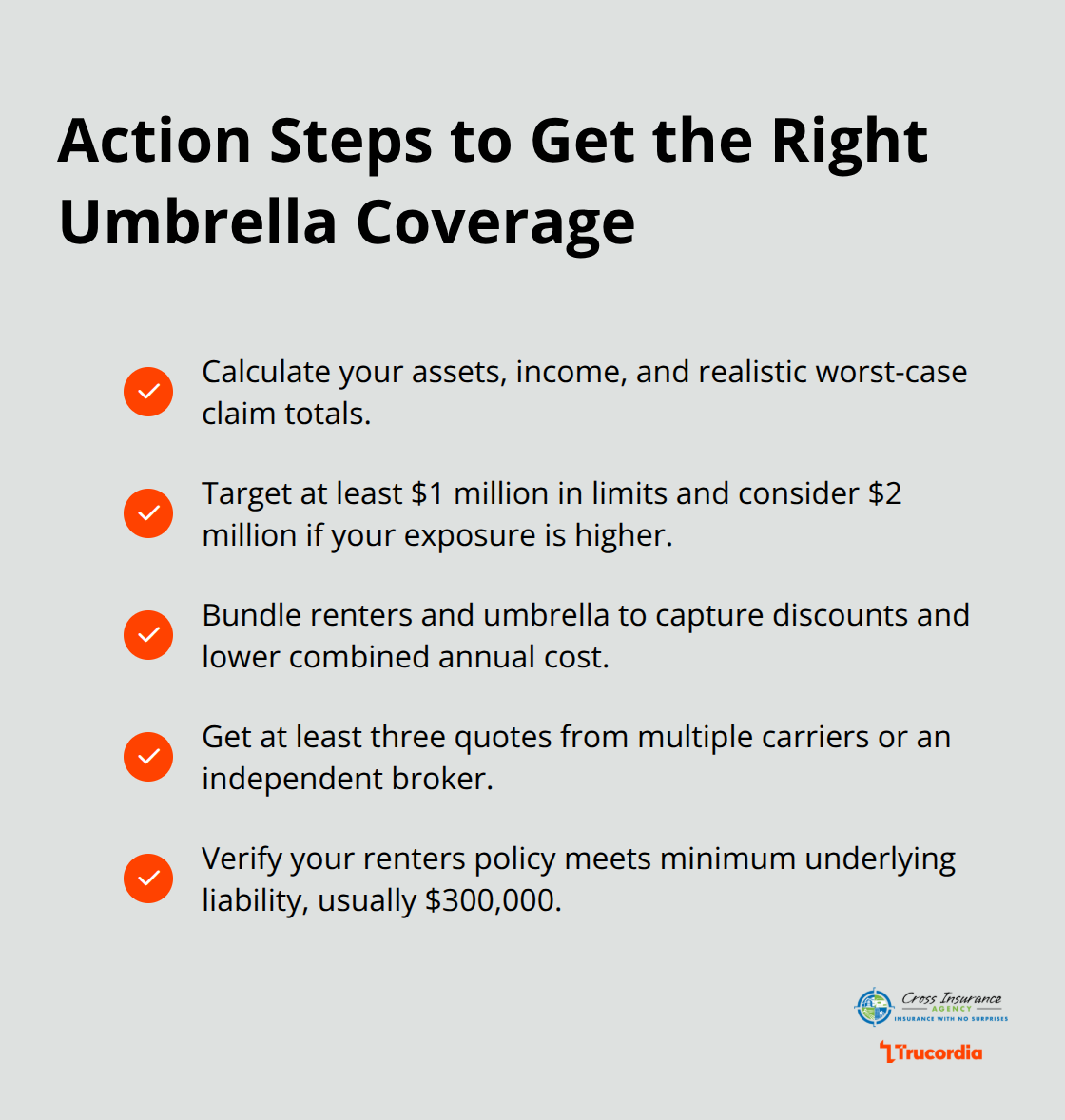
Most Washington renters should carry at least $1 million in umbrella limits, and many should consider $2 million. The annual cost difference between $1 million and $2 million is roughly $100 to $150, making the upgrade nearly negligible compared to the protection it provides. Your renters insurance agent can help you determine exact limits, but don’t accept their first recommendation without pushback. Agents often suggest $1 million as a default, which works fine for renters with minimal assets but leaves others exposed.
Tell your agent your income, your assets, and ask them to calculate what a worst-case liability claim could look like in your specific situation. Then ask what umbrella limit covers that exposure completely.
Bundle Coverage and Shop Multiple Carriers
When you bundle renters and umbrella coverage through one agent or carrier, discounts typically drop your combined annual cost to $200 to $400-far cheaper than the financial devastation of a single uninsured claim. Independent brokers shop multiple carriers to find the best rates, which matters because umbrella pricing varies dramatically between insurers. A policy that costs $300 annually through one carrier might cost $150 through another.
Get Multiple Quotes and Verify Your Foundation
Don’t settle for the first quote. Get three quotes minimum before deciding, and verify that your base renters policy maintains the minimum liability limits your umbrella requires-usually $300,000. Without that foundation, your umbrella won’t activate when you need it most.
Final Thoughts
A renters umbrella policy in WA protects your financial future when a single liability claim exceeds your base renters insurance limits. Standard renters coverage maxes out fast, medical costs and legal fees escalate quickly, and Washington courts award substantial damages. Without umbrella protection, your personal assets face seizure and wage garnishment after a serious claim.
The cost of inaction far outweighs the cost of coverage-umbrella policies run $100 to $300 annually for $1 million in additional limits, yet they protect everything you own. Most Washington renters should carry at least $1 million in umbrella limits, and many benefit from $2 million. Bundling renters and umbrella coverage through one agent typically reduces your combined annual cost to $200 to $400 while delivering the protection you actually need.
Your next step is simple: calculate what you own, determine your liability exposure, and contact Cross Insurance Agency to get multiple quotes from top-rated carriers. Our licensed agents work with you to assess your actual liability exposure and recommend limits that match your situation, not generic defaults. We handle the complexity so you can focus on what matters.
Disclaimer: The information provided in this blog is for general informational purposes only and does not constitute legal, financial, or insurance advice. Coverage options, terms, and availability may vary. Please consult with a licensed professional for advice specific to your situation. Artificial intelligence may have been used to generate text and images in some blog articles.


